
A lead messages you on WhatsApp. They have real interest, made the effort to find your number and send a message. But your sales team is in a meeting, or attending to another client, or simply didn't see the notification. 10 minutes pass. 30. An hour. When someone finally responds, the lead has already spoken with your competitor —and bought from them.
This is not an isolated case. According to a Harvard Business Review study, companies that respond within the first 5 minutes are 21 times more likely to qualify the lead than those that take 30 minutes. And according to data from InsideSales.com, 78% of B2B buyers choose the first salesperson to respond. Not the best. Not the cheapest. The first.
The problem is not that your product is bad or that your team is slow. The problem is that the process between "the lead messaged" and "a human salesperson responds" has too many leakage points. And on WhatsApp, where the expectation for a response is immediate, every minute of delay is a lead that cools down.
Table of Contents
- Where leads are lost exactly
- The Real Cost of Responding Late
- Why the Problem Worsens with Volume
- How to close leakage points step by step
- Common mistakes when trying to solve it
- Metrics you should measure
- Frequently asked questions
Where leads are lost exactly
To understand why WhatsApp leads are lost, we need to look at the complete journey from when the message arrives until a salesperson works on it. The typical funnel has 5 stages, and there is leakage at each one:
Stage 1: Message Reception
The lead messages. If your company uses WhatsApp Business App (the free version with a single number), the message arrives on a cell phone. A cell phone that might be on silent mode, out of battery, or in the pocket of someone driving. There's no queue, no prioritization, no centralized record.
Typical Leakage: 10-15% of messages are seen with a delay of more than 1 hour because no one was looking at the phone.
Stage 2: Classification
Assuming someone saw the message, now it's time to decide: is it a sales lead, a support inquiry, a vendor, spam? In manual operations, that classification is done by the person who saw the message first —who isn't always the right person to respond.
Typical Leakage: 15-20% of leads are assigned to the wrong department, generating internal bounces that add 30-60 minutes to the response time.
Stage 3: Assignment
The lead is for sales. Which salesperson does it go to? If there are no clear rules, the usual happens: the fastest salesperson takes the easy ones, the new team member gets nothing, and complex leads (those with higher value) are left in limbo.
Typical Leakage: 20-25% of leads remain unassigned for more than 2 hours in teams of 5+ salespeople.
Stage 4: First Response
The salesperson sees the assigned lead. But they are finishing a quote, or on the phone with another client. The response is delayed. It's not ill will—it's a lack of tools to prioritize.
Typical Leakage: 25-30% of leads receive a first response after 30 minutes. By then, half have already contacted another company.
Stage 5: Follow-up
The salesperson responded, but the lead did not reply immediately. When do they follow up? In 2 hours? The next day? Without a task or reminder system, follow-up depends on the salesperson's memory.
Typical Leakage: 35-40% of leads who do not respond to the first message never receive a second contact.
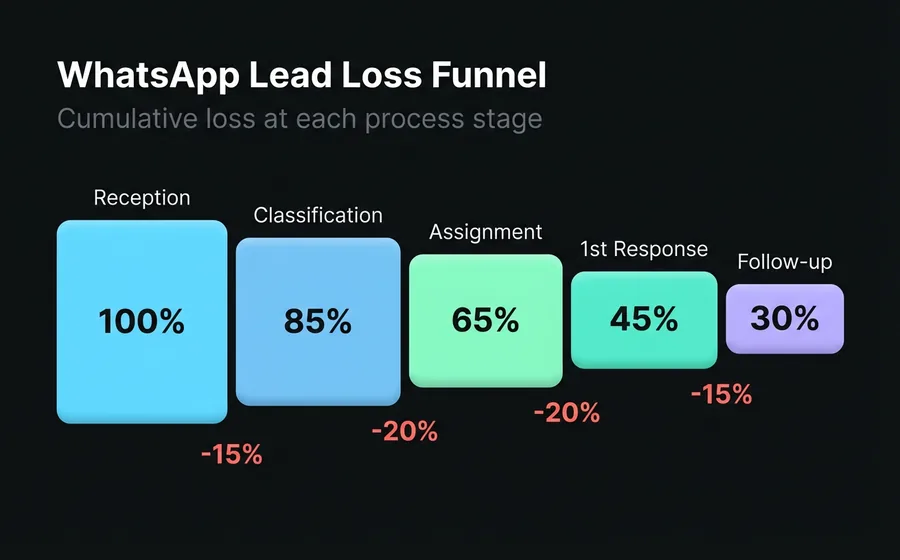
Adding up all the leakages, it's not difficult to reach that 70% loss. This data is not made up: an analysis by Drift of 433 B2B companies found that only 27% of web leads ever receive a response. On WhatsApp, where the channel is faster but expectations are higher, the number worsens.
The Real Cost of Responding Late
Let's use concrete numbers. Let's assume a medium-sized operation:
- 500 leads/month arrive via WhatsApp
- Average Ticket: USD 200
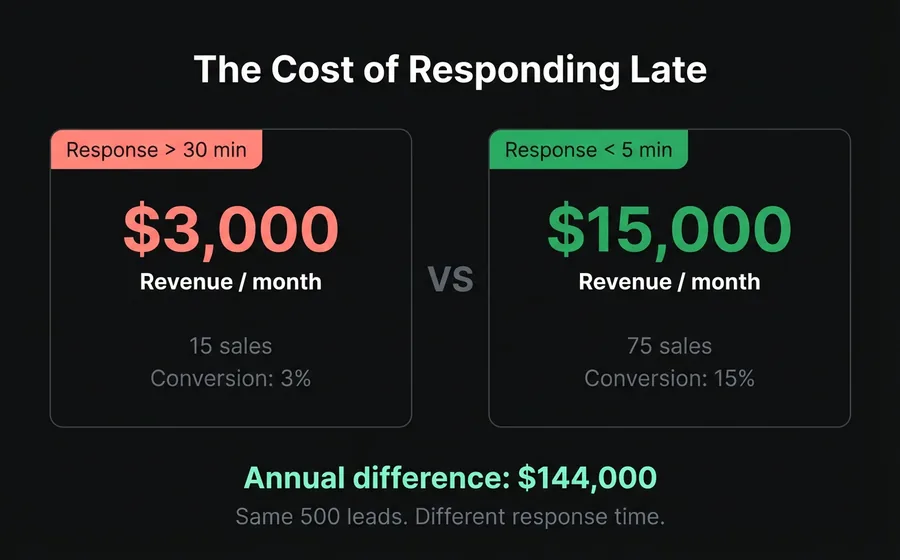
- Conversion Rate with response in <5 min: 15%
- Conversion Rate with response in >30 min: 3%
With fast response: 500 × 15% = 75 sales = USD 15,000/month. With slow response: 500 × 3% = 15 sales = USD 3,000/month.
The difference is USD 12,000 per month. USD 144,000 per year. And that's without counting the acquisition cost of those 500 leads (campaigns, ads, SEO) that you threw away by not responding on time.
The Harvard Business Review data is conclusive: the chances of successfully contacting a lead decrease 10 times if the response takes more than 5 minutes. Not 10%. Ten times.
The Compound Effect
Every lost lead is not just a lost sale—it's a customer who bought from your competitor, who now has a positive experience with them, and who will probably recommend them. The loss is double: you lost the sale AND strengthened your competitor.
Why the Problem Worsens with Volume
If you have 10 leads per day and a dedicated salesperson, the impact is manageable. But when the volume grows—because you invested in ads, because word-of-mouth works, because you're in high season—the manual system collapses.
Signs Your Operation Has Already Collapsed
- Unread messages at the end of the day. If your team ends the day with unread WhatsApp messages, you are losing leads during business hours.
- Leads who write "hello?" multiple times. The lead is waiting and telling you so.
- Salespeople stepping on each other's toes. Two salespeople respond to the same lead, or worse: none respond because each assumed the other would.
- You don't know how many leads came in yesterday. If you can't answer this question with an exact number, you lack visibility.
- Weekend leads are lost. If your business receives inquiries on Saturdays and Sundays but no one attends to them until Monday, those leads are dead.
The underlying problem is that WhatsApp Business App was designed for one person attending from their cell phone, not for a sales team. When you scale beyond 1-2 people, you need real infrastructure.
How to close leakage points step by step
Step 1: Immediate automatic response (0 seconds)
When a lead writes, a chatbot must respond in less than 3 seconds with a message that does two things: (a) confirm that the message was received, and (b) ask the first qualification question.
You don't need a sophisticated bot for this. A message like "Thank you for writing to us. To connect you with the right advisor, could you tell me what product you're interested in?" already reduces leakage in stage 1 to practically zero. The lead knows they've been seen. That alone changes the equation.
The WhatsApp Business API allows configuring this automatic response as part of the chatbot flow, with conditional logic to route based on the response.
Step 2: Automatic Qualification (30 seconds - 2 minutes)
The chatbot asks 2-3 key questions before assigning to a salesperson: product of interest, company size, location, estimated budget. This eliminates stage 2 (manual classification) and gives the salesperson real context before the first human interaction.
With AsisteNLP you can train these questions as fixed intentions (deterministic, without risk of hallucination), or with AsisteGPT you can let the bot maintain a natural qualification conversation using your knowledge base.
Step 3: Smart Assignment (automatic)
Instead of salespeople fighting over leads or ignoring them, the system automatically assigns based on rules: by territory, by product, by availability, by round-robin, or by skill. The lead goes directly to the correct salesperson with the qualification context.
AsisteChat handles this assignment in its omnichannel inbox: the lead enters via WhatsApp, the bot qualifies, and the conversation appears in the assigned salesperson's queue with all previous history.
Step 4: SLA Alerts (real-time)
If the assigned salesperson does not respond in X minutes, the system escalates: it notifies them, reassigns them to another salesperson, or alerts the supervisor. Without SLA alerts, the lead remains in an invisible queue waiting for someone to remember.
Setting up a 5-minute first-response SLA is the single change that has the most impact on conversion. Not because 5 minutes is magic, but because it forces the team to prioritize new messages over ongoing tasks.
Step 5: Automated Follow-up (hours - days)
If the lead does not respond after the first human interaction, the system schedules automatic follow-ups: a message at 2 hours, another the next day, a third at 48 hours. After 3 attempts without a response, the lead is marked as cold and moved to a nurturing campaign.
Wadalio allows scheduling these follow-ups as individual messages or as part of a campaign, with personalization by name and previous conversation context.
Step 6: After-hours support (24/7)
Leads don't respect office hours. A chatbot operating 24/7 can qualify, inform, and schedule appointments for the next day, ensuring no weekend or late-night lead is lost. The salesperson arrives on Monday with qualified leads and scheduled appointments, instead of a list of unread messages.
Common mistakes when trying to solve it
1. Adding more salespeople without changing the process
If the process has leaks, more salespeople only means more people losing leads. Before hiring, close the leak points. A team of 3 salespeople with an automated process converts more than a team of 8 doing everything manually.
2. Using WhatsApp Business App with multiple phones
Some try to scale by buying several phones with the same number (spoiler: it's not possible) or by using different numbers per salesperson (the customer doesn't know which one to write to). The solution is the WhatsApp Business API, which allows multiple agents to connect to the same number from a centralized platform.
3. Automating without qualifying
A bot that only says "Thanks for your message, we'll contact you soon" is marginally better than having no bot. If you don't qualify on the first contact, the salesperson still lacks context, and the conversation starts from scratch. Automation without intelligence is noise.
4. Not measuring the first response time
What isn't measured isn't improved. If you don't have a dashboard showing the average first response time per salesperson, you don't know if the problem is getting better or worse. Many companies believe they respond in 5 minutes when the actual average is 45.
5. Treating all leads equally
A lead asking "how much does the Enterprise plan cost?" and one asking "do you have WhatsApp?" are not the same. The first is ready to buy. The second is exploring. Without qualification, both receive the same treatment (or worse: the second steals time from the first).
Metrics you should measure
If you're going to implement improvements, you need a baseline and tracking metrics:
| Metric | What it measures | Target |
|---|---|---|
| First Response Time (FRT) | Seconds from when the lead writes until they receive a human or bot response | < 60 seconds (bot) + < 5 min (human) |
| Response Rate | % of leads that receive at least one response | > 95% |
| Qualification Rate | % of leads that complete the bot's qualification flow | > 60% |
| Assignment Rate | % of leads assigned to a salesperson in < 5 min | > 90% |
| Unattended Leads | Number of leads that never received a human response within 24h | 0 |
| Conversion Rate by Speed | Conversion segmented by first response time | Continuous tracking |
The most revealing metric is Segmented FRT: if you graph conversion vs. first response time, you'll see a step-like drop. The exact point where your conversion plummets is your real window of opportunity.
Frequently asked questions
Is 70% a real figure or an estimate?
It's an estimate based on composite data. The Drift (2021) study found that 73% of web B2B leads never receive a response. On WhatsApp, where the expectation of immediacy is higher, the loss rate due to delay is amplified. The exact number varies by industry, but the order of magnitude is consistent: most leads are lost due to speed, not quality.
Can a chatbot replace a salesperson?
No, and it shouldn't. The chatbot handles the first 30-120 seconds: it receives, qualifies, assigns. The salesperson does what a bot cannot: build trust, negotiate, close. The mistake is to have the bot sell or the salesperson qualify. Each in their role.
How much does it cost to implement WhatsApp Business API?
The cost has three components: (1) the platform that manages the API (from USD 20/month in plans like the AsisteClick Business), (2) Meta's per-conversation cost (varies by country, ~USD 0.05-0.15 per business-initiated conversation), and (3) the optional AI cost if you use smart chatbots. For an operation of 500 leads/month, the total cost is around USD 100-300/month — a fraction of the revenue you recover by responding on time.
How long does it take to see results?
The impact on first response time is immediate (day 1 with an active bot). Conversion improvement is noticeable within the first 2-4 weeks, when the volume is sufficient to compare before vs. after. The full ROI (including reduced team workload and improved follow-up) consolidates in 60-90 days.
Can I start without a chatbot, just with automatic assignment?
Yes. If a chatbot seems like a big step, starting with an omnichannel inbox that centralizes messages and assigns them automatically already significantly reduces loss. The recommended sequence is: (1) centralize → (2) assign → (3) measure → (4) automate with a bot. But the sooner you add immediate automatic response, the better.
Conclusion
WhatsApp leads are lost due to a process problem, not a product problem. The delay between "the lead wrote" and "a salesperson responded" is where the sale dies. And the solution is not more salespeople, but less friction.
The three changes with the greatest impact, in order:
- Immediate automatic response — eliminate the silence of the first few minutes
- Automatic qualification and assignment — ensure the lead reaches the right salesperson with context
- SLA alerts and follow-up — ensure no lead goes unattended
If your operation handles more than 100 leads per month via WhatsApp and today you rely on someone checking their phone to respond, the math is clear: you're leaving money on the table every day.
Platforms like Bruno combine WhatsApp Business API, Omnichannel inbox, NLP chatbots y GPT, Bulk sending y CRM in one place — exactly the infrastructure you need to ensure no lead is lost between the message and the sale.
Continue reading
- NLP chatbot vs GPT vs hybrid: which to implement based on your use case — if you are evaluating what type of chatbot to use for automatic qualification
- How Peugeot Belchamp transformed its lead strategy with AsisteClick — a real-world implementation case with quantified results