
"How much does the chatbot save us?" This is the question the operations manager asks the technology team every time renewal comes around. And most of the time, the answer is an awkward silence followed by "well, it resolves many queries." That's not ROI. That's an anecdote.
The problem isn't that the chatbot doesn't generate a return — in most cases, it does. The problem is that no one measured it. And if you can't put a number in a spreadsheet, the chatbot falls into the "expense" category instead of "investment." That's when they don't renew you.
This article gives you the concrete formula to calculate a chatbot's ROI in less than 10 minutes, using data you already have in your operation. It's the same logic used by companies that renew year after year — not because "they think it works," but because they can demonstrate exactly how much money it generates for them.
Table of Contents
- Why most don't measure ROI (and why it matters)
- The ROI formula of a chatbot
- Variable 1: Support Savings
- Variable 2: Qualified leads that wouldn't exist without a bot
- Variable 3: Retention and satisfaction
- Variable 4: Total chatbot cost
- How to calculate your ROI step-by-step
- Total benefit
- Qualified leads (high seasonality)
- 3. Ignoring the opportunity cost
Why most don't measure ROI (and why it matters)
According to a Juniper Research report, chatbots will save companies over USD 11 billion annually by 2026. But ask an individual company how much their bot saves them, and most don't have a number.
The reasons are always the same:
-
They don't have a baseline. If you didn't measure how much the operation cost BEFORE the chatbot, you can't calculate how much you save AFTER. Many companies implement the bot without taking a snapshot of the previous state.
-
They confuse activity with results. "The bot responded to 3,000 messages this month" is not ROI. The question is: how many of those 3,000 would have required a human agent? How many generated a sale? How many prevented a support ticket?
-
The benefit is diffuse. The chatbot touches multiple areas: it reduces support load, qualifies leads for sales, improves customer experience, frees up team hours. Because it touches everything, no one takes ownership of measuring it.
-
Fear of the result. If the number is bad, someone has to explain why the budget was spent. So it's more comfortable not to measure.
The result is that the chatbot is renewed (or not) by intuition, not by data. And that's a problem because: - If the ROI is positive and you don't demonstrate it, you risk it being canceled due to "budget adjustment" - If the ROI is negative and you don't know it, you keep paying for something that doesn't work without fixing it - If the ROI is huge and you don't communicate it, you lose the opportunity to ask for more budget to scale
The ROI formula of a chatbot
The formula is simple in its structure. The complexity lies in obtaining the data — but each variable can be calculated with information your operation already generates.
ROI (%) = ((Total Benefit - Total Cost) / Total Cost) × 100
Where:
Total Benefit = Support Savings + Revenue from Qualified Leads + Retention Value
Total Cost = Platform + AI Tokens + Setup/Maintenance Hours
A 200% ROI means that for every dollar you invest in the chatbot, you generate 3 (the original dollar + 2 in return). A 0% ROI means the chatbot pays for itself but generates no extra. A negative ROI means you are losing money.
In practice, well-implemented chatbots in B2B customer service operations have an ROI of 150-400%. Poorly implemented ones (without qualification, without metrics, without iteration) hover around 20-80%.
Let's break down each variable.
Variable 1: Support Savings
This is the easiest variable to calculate and the one with the greatest impact in most operations. The logic: each query the bot resolves without human intervention saves you the cost of an agent handling that query.
The savings formula
Monthly Savings = Queries resolved by bot × Cost per human query
How to obtain each data point
Queries resolved by bot (without escalation to human)
It's not "messages the bot received." It's conversations where the bot responded satisfactorily and the customer DID NOT ask to speak with a human afterward. In AsisteChat, this is measured as conversations closed by bot vs. transferred to agent.
Example: if the bot received 2,000 conversations and transferred 600 to agents, it resolved 1,400.
Cost per human query
Take the total cost of your support team (salaries + tools + overhead) and divide it by the number of queries they handle per month.
Example: team of 3 agents, total cost USD 4,500/month, handle 1,500 queries → USD 3 per query.
Full example
| Data Point | Value |
|---|---|
| Conversations received by the bot | 2,000/month |
| Resolution rate without human | 70% |
| Queries resolved by bot | 1,400/month |
| Cost per human query | USD 3 |
| Monthly savings in support | ROI (%) = ((Total benefit - N) / N) × 100 |
70% resolution is realistic for a hybrid bot (NLP + GPT) with a good knowledge base. NLP-only bots with few intentions hover around 40-50%. GPT bots with well-configured RAG can reach 75-85%.
Variant: savings by reassignment, not by reduction
Not all companies want to reduce staff. Many prefer to reassign: agents who previously answered "what are the hours?" now handle complex, higher-value inquiries. In that case, savings are calculated as:
Liberated hours × Value of those hours in higher-impact tasks
If an agent dedicated 4 hours/day to repetitive inquiries and now dedicates them to closing sales or resolving complex cases, the real value is greater than the salary cost.
Variable 2: Qualified leads that wouldn't exist without a bot
This variable applies when the chatbot participates in the sales funnel — it receives leads, qualifies them, and transfers them to salespeople with context. If your bot is only for support, you can skip this variable (but consider that you might be leaving revenue on the table).
The incremental revenue formula
Revenue per leads = Leads qualified by bot × Conversion rate × Average ticket
What counts as a "bot-qualified lead"
It's a lead that: 1. Arrived through a channel where the bot is the first line (WhatsApp, webchat, Instagram) 2. Completed the bot's qualification flow (answered questions about product, budget, company size, etc.) 3. Was transferred to a salesperson with the qualification context
The key is the counterfactual question: would this lead have been attended to without the bot? If the bot operates 24/7 and a lead wrote at 11 PM on a Saturday, the answer is almost certainly no. If the bot responds in 3 seconds and without it the lead would have waited 45 minutes (and left), the answer is also no.
According to data from an analysis of WhatsApp leads, companies that respond in less than 5 minutes are 21x more likely to qualify the lead. The bot guarantees a response in seconds — that's revenue that wouldn't otherwise exist.
Full example
| Data Point | Value |
|---|---|
| Leads that pass through the bot | 500/month |
| Qualification rate (complete the flow) | 60% |
| Qualified leads transferred to salespeople | 300/month |
| Leads that would NOT have been attended without a bot (after-hours, overflow) | 40% = 120 |
| Qualified lead conversion rate | 12% |
| Incremental sales | 14/month |
| Average ticket | USD 200 |
| Incremental monthly revenue | Using the numbers from the previous examples: |
Note: We only count incremental leads (those that would NOT have been attended without a bot). Other leads also benefit from the bot (better qualification, shorter response time), but we do not attribute them 100% to the bot to be conservative.
Variable 3: Retention and satisfaction
This is the most difficult variable to quantify but often the most valuable in the long term. A chatbot that responds quickly, resolves well, and escalates when necessary improves the customer experience — and customers with a good experience renew more and buy more.
Ways to measure the impact on retention
CSAT post-bot: if you measure satisfaction after interactions with a bot vs. without a bot, you can compare directly. A delta of +5-10 points in CSAT correlates with 10-15% more annual retention according to Bain & Company data.
Segmented NPS: compare NPS of customers who frequently interact with the bot vs. those who don't.
First Contact Resolution rate (FCR): if the bot resolves in the first interaction without the customer having to write again, satisfaction increases. FCR > 80% is a strong indicator.
Simplified calculation of retention value
Retention Value = Additional retained customers × LTV × Percentage of attribution to the bot
| Data Point | Value |
|---|---|
| Active customers who interact with the bot | 200 |
| Improvement in retention attributable to the bot | +5% |
| Additional retained customers | 10/year |
| Average LTV (lifetime value) | USD 2,400 |
| Attribution to the bot (conservative) | 30% |
| Annual Retention Value | USD 7,200 (= USD 600/month) |
Be conservative with attribution. The bot is not the only retention factor — but it is a factor. 30% attribution is reasonable if the bot is the primary support channel.
Variable 4: Total chatbot cost
The cost has fixed and variable components. Don't forget hidden costs.
Cost components
| Component | Type | Example |
|---|---|---|
| Chatbot platform | Fixed monthly | USD 20-260/month depending on plan (see pricing) |
| AI tokens (if you use GPT/LLM) | Variable by usage | USD 40-200/month for 2K conversations |
| WhatsApp conversation cost (Meta) | Variable by usage | USD 0.05-0.15 × company-initiated conversations |
| Initial setup hours | One-time | 20-80 hours × cost/hour of the bot builder |
| Monthly maintenance hours | Fixed monthly | 4-16 hours/month × cost/hour |
| Team training | One-time | 2-8 hours |
Example: total monthly cost
| Component | Cost |
|---|---|
| Platform (AI Plus plan) | USD 260/month |
| GPT Tokens | USD 80/month |
| WABA Conversations (1,000 initiated per company) | USD 100/month |
| Maintenance (8 hrs × USD 15/hr) | USD 120/month |
| Prorated Setup (60 hrs / 12 months) | USD 75/month |
| Total monthly cost | USD 635/month |
For annual ROI calculation, remember to prorate one-time costs (setup, training) over 12 months.
How to calculate your ROI step-by-step
Step 1: Collect data from the previous month
You need these 8 data points. If you don't have any, use the suggested estimate.
| Data Point | Where to find it | If you don't have it |
|---|---|---|
| Total bot conversations | Platform dashboard | Sum tickets/chats from the channel |
| Conversations resolved without human intervention | Dashboard or (total - transferred) | Estimate 50-70% of the total |
| Monthly cost of the support team | HR / payroll | (Average salary × agents) × 1.3 overhead |
| Queries handled by humans/month | CRM or ticket report | Estimate by capacity (40-60/day/agent) |
| Leads that went through the bot | Sales report or CRM | Filter leads from the channel with bot |
| Closed sales from bot leads | CRM | Cross-reference closed opportunities with origin |
| Average ticket | Revenue / CRM | Total revenue / number of sales |
| Monthly cost of the platform + AI | Supplier invoice | Sum all items |
Step 2: Calculate each variable
With the data from step 1, complete this spreadsheet:
Total benefit = C + I + M = USD ___/month - (A) Queries resolved by bot = /month - (B) Cost per human query = support team cost / human queries = USD - (C)
Consolidated example Revenue per leads - (D) Leads qualified by bot = /month - (E) % incremental leads (after-hours + overflow) = % - (F) Incremental leads = D × E =
Variable % - (H) Average ticket = USD ___ - (I) Incremental revenue = F × G × H = USD ___/month
Revenue from leads (optional, use if you have CSAT/NPS data) - (J) Additional customers retained/year =
- (K) LTV = USD
(L) Bot attribution = 30%
Retention value = J × K × L / 12 = USD ___/month
Total cost
- (N)
| Total cost = platform + tokens + WABA + maintenance = USD ___/month | Step 3: Calculate ROI |
|---|---|
| Total benefit = C + I + M = USD ___/month | ROI (%) = ((Total benefit - N) / N) × 100 |
| Consolidated example | Using the numbers from the previous examples: |
| Variable | Monthly value |
| Support savings | USD 4,200 |
| Revenue from leads | USD 2,800 |
| Retention | ((7,600 - 635) / 635) × 100 = 1,096% |
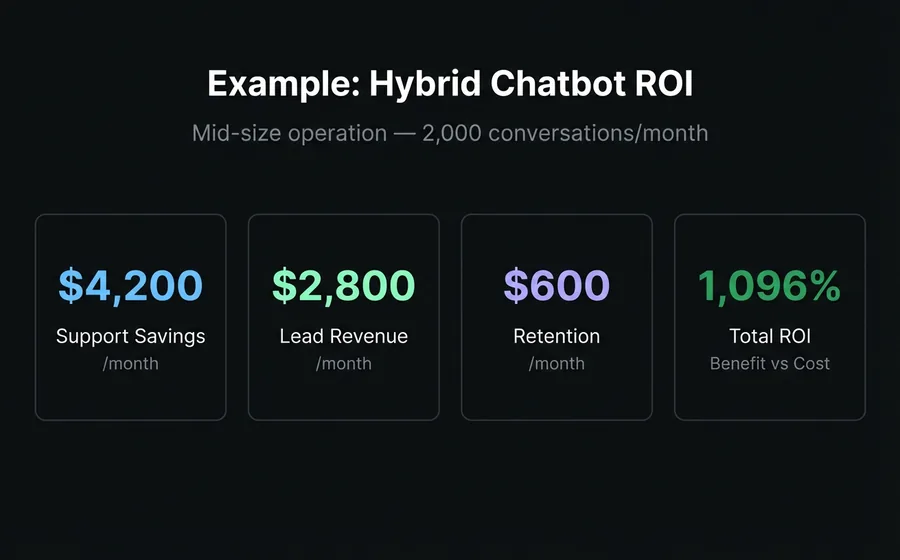
USD 600
Total benefit
USD 7,600
| Total cost | USD 635 | ROI | Yes, a 10x ROI is possible and is not uncommon in well-configured medium-sized operations. The key is that the cost of the chatbot (USD 635/month) is a fraction of the cost of the human team it partially replaces or complements. |
|---|---|---|---|
| Benchmarks by industry | 300-800% | Not all industries see the same ROI. The most important variables are the volume of inquiries, the average ticket, and the cost of the support team. | Industry |
| Typical ROI | 200-500% | Dominant variable | Note |
| eCommerce | 150-400% | Support savings (high volume, repetitive queries) | Seasonal peaks: Black Friday, Christmas |
| Finance | 400-1000% | Qualified leads (high average ticket) | Regulation limits bot responses → more transfers |
| Healthcare | 200-600% | Support savings + retention (appointments, reminders) | Post-bot CSAT is a huge differentiator |
| ISP / Telco | 150-400% | Support savings (massive volume, simple queries) | "When will service be restored?" = 30% of queries |
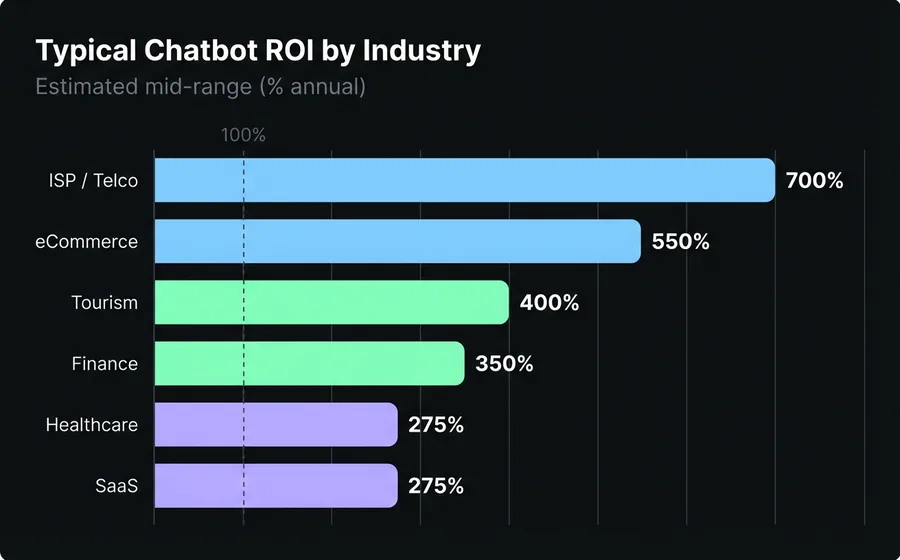
Tourism
Qualified leads (high seasonality)
Concentrated revenue → 24/7 bot captures off-hours
SaaS
Retention + leads (onboarding, technical support)
High LTV amplifies retention value
ISPs and telecommunications companies see the highest ROI because they combine massive volume (thousands of queries about the same problem: "service is down") with extremely repetitive queries that an NLP bot resolves with 2 intents.
Common errors when measuring ROI
1. Counting all bot interactions as "resolved"
If the bot says "Thank you for your query" and the customer leaves frustrated, that's not resolution. Measure resolution as: the customer DID NOT recontact within the next 24 hours, OR responded positively to a satisfaction survey, OR completed the desired action (purchase, scheduled appointment, etc.).
2. Not separating incremental leads from leads that would have arrived anyway
If a lead writes at 10 AM on a Tuesday and your team of 5 salespeople was available, the bot helped with speed but was not the determining factor. Leads at 11 PM on Saturday, those from overflow when all agents are busy, and those who would have abandoned due to wait time — those are incremental.
3. Ignoring the opportunity cost
If your agents dedicate 4 hours daily to queries that the bot could resolve, those 4 hours are not "free" — they are hours that could be closing sales, resolving complex cases, or doing upsells. The opportunity cost is usually 2-3x the direct salary cost.
4. Measuring only the first month
A chatbot's ROI improves over time because: (a) the knowledge base is enriched, (b) the bot learns from conversations it couldn't resolve, (c) the team optimizes flows based on real data. Month 1 rarely reflects the real potential. Measure at 90 days.
5. Not including the cost of NOT having a chatbot If your alternative to the chatbot is hiring 2 more agents, the cost of the alternative is part of the calculation. The chatbot's ROI vs. the alternative (more staff, other software, doing nothing) is what matters for budget decisions. Frequently Asked Questions
How long does it take for a chatbot to generate positive ROI?
In operations with more than 500 queries/month, the break-even point is usually between month 2 and month 4. Month 1 includes the prorated setup cost and a lower resolution rate (the bot is still learning). From month 3 onwards, the curve stabilizes and ROI grows month by month.
Does ROI change between an NLP bot and a GPT bot?
Yes. An NLP bot has lower operational cost (no tokens) but a lower resolution rate (40-55%). A GPT bot with RAG has a higher cost per conversation but higher resolution (65-85%). The
hybrid approach
optimizes both: NLP for frequent and low-cost queries, GPT for the long tail. In practice, the hybrid usually has the best net ROI.
How do I present ROI to the board / management?
Three numbers: (1) how much the chatbot costs per month, (2) how much it saves + generates, (3) the multiple (for every dollar invested, X returns). Accompany with the monthly trend (ROI improves month by month) and a comparison with the alternative (hiring N agents would cost Y). A bar chart with cost vs. benefit per month is more persuasive than a table.
What if my operation is small (less than 200 queries/month)?
The ROI in support savings may be low because the volume does not justify the platform's fixed cost. But the ROI in qualified leads and 24/7 availability can compensate. For small operations, the main argument is not "savings" but "I don't lose sales outside business hours." This is calculated with Variable 2.
How often should I recalculate ROI? Bruno Monthly for the first 6 months (to see the improvement curve), quarterly thereafter. Including it in the monthly operations report normalizes the chatbot as a business tool, not an "IT project." AsisteChat Conclusion AsisteNLP y AsisteGPT A chatbot's ROI is composed of three sources of value: support savings (the easiest to measure), incremental revenue from leads (the most impactful in commercial operations), and retention through improved experience (the most valuable in the long term). AsisteCRM The formula is not complicated. What is difficult is having the habit of measuring. Companies that calculate their ROI every month are the ones that optimize their bots, justify budgets, and ultimately scale.
If you haven't measured your chatbot's ROI yet, do it this month with the data you have. If the number is good, communicate it. If it's bad, now you know which variable to fix.
- Platforms like provide you with the data for the calculation directly from the dashboard: conversations resolved by bot, transfers to agents, qualified leads, response times. With
- for the omnichannel inbox, for bots, and
- for tracking leads and sales, all the information you need for the formula is in one place. Keep reading