
Your sales team receives 200 leads via WhatsApp per month. Of those 200, only 30 have budget, real need, and decision-making power. The problem is that your salespeople don't know which 30 those are until they've already invested hours talking to the other 170.
Qualify leads on WhatsApp with an AI Agent solves exactly that: a conversational agent that talks to each prospect, understands what they need, evaluates if they meet your sales criteria, and only transfers those ready to move forward to the human team. The rest receive genuine attention but without consuming your salespeople's time.
In this article, we explain how an AI lead qualification Agent works on WhatsApp, what to configure to make it effective, the errors you should avoid, and how to implement it step-by-step — based on a real AI agent already in production.
What is an AI lead qualification Agent
An AI lead qualification Agent is an AI agent that converses with prospects to determine if they meet your sales team's criteria before transferring them to a human salesperson.
The difference with a web form or a rule-based bot is fundamental: a generative AI Agent does not ask questions like an interrogation. It maintains a natural conversation, intersperses qualification questions within the dialogue, answers product questions in real-time, and handles objections with prepared arguments.
At the end of the conversation, the bot classifies the prospect into one of two categories:
- Hot lead: meets the criteria (budget, timeline, authority, need). The bot offers to schedule a call or transfers directly to the salesperson.
- Cold lead: does not meet the criteria today. The bot thanks them, leaves the door open, and optionally offers to send information via email.
This automatic classification means your sales team only receives leads that have already passed an intelligent filter. No more calls to prospects who "were just asking" or hours invested in leads without a budget.
Why qualifying leads on WhatsApp matters more than on other channels
WhatsApp is not just another channel. In Latin America, it is the sales channel.
The numbers confirm it:
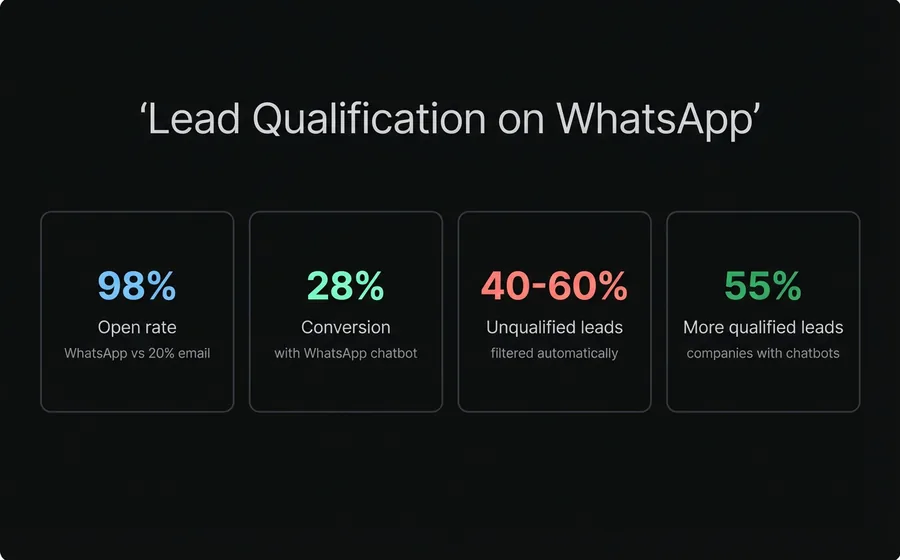
- 98% open rate in WhatsApp messages (vs. 20-25% in email)
- 80% of the first commercial interactions in LATAM occur via messaging
- 28% average conversion rate in WhatsApp campaigns with an AI Agent
- 72% of Latin American consumers have made at least one purchase through a messaging app
But this volume has a problem: if you receive 50 messages per hour on WhatsApp, your team cannot manually qualify each one. Salespeople end up responding to everything — qualified and unqualified leads alike — and real opportunities get diluted among inquiries that won't close.
According to industry data, between 40% and 60% of leads that reach sales are unqualified. That means more than half of your sales team's time is spent on prospects who are not going to buy. An AI qualification Agent eliminates that inefficiency by filtering before the salesperson intervenes.
The equation is straightforward: 55% of companies using AI Agents report a higher volume of qualified leads. Not because they generate more leads — but because they qualify the ones they already have and stop losing the good ones among the bad.
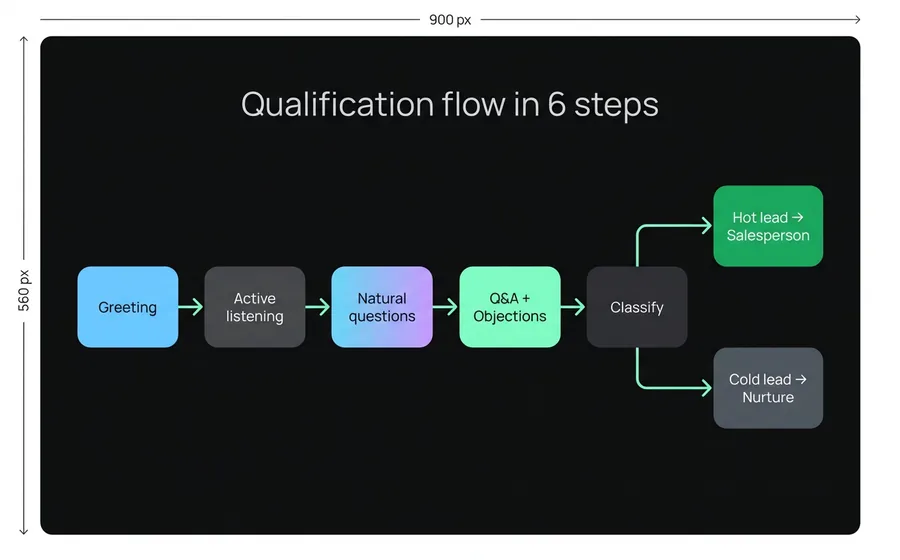
How it works: the 6-step flow
An AI-powered lead qualification Agent follows a conversational flow designed to obtain the information you need without the prospect feeling like they are filling out a form.
Step 1: Greeting and open-ended question
The bot introduces itself with your company's name and asks an open-ended question: "What are you interested in knowing?" or "What are you looking for?". It does not start with closed-ended questions or a menu of options.
This first message is critical. If the bot sounds like a form ("Select an option: 1. Sales, 2. Support, 3. Information"), the prospect disengages. If it sounds like a person genuinely interested in helping, the conversation flows.
Step 2: Active listening
Before asking qualifying questions, the bot listens to what the prospect needs. If they say "I'm looking for management software for my 50-person company", the bot already has valuable information without having asked anything.
Generative AI understands the context of the message and automatically extracts relevant data: company size, type of product sought, urgency level. This reduces the number of explicit questions needed.
Step 3: Natural qualifying questions
This is where the bot intersperses the questions your sales team needs — but within the conversation, not as a questionnaire.
Instead of asking "What is your budget?", the bot says "Do you already have an investment range defined for this, or is it something you are still evaluating?". Instead of "Are you the decision-maker?", it asks "Are you evaluating this directly or is someone else on your team involved in the decision?".
The rule is: maximum 1-2 questions per message. Never an interrogation.
Step 4: Answering product questions
The prospect will ask things: prices, features, differences with competitors, implementation timelines. The bot has access to your product information and responds with concrete data — not evasions.
If the bot does not have the information to answer something, it says so honestly: "The sales team can better resolve that. Would you like them to contact you?". Honesty generates more trust than a fabricated answer.
Step 5: Handling objections
"It's too expensive." "We already have a provider." "We don't have time to implement something new."
A well-configured qualifying bot has prepared responses for each common objection:
| Objection | Bot's response |
|---|---|
| "It's too expensive" | Financing options, 14-day free trial, discount for annual payment |
| "We already have a provider" | Free migration, feature comparison, no-commitment trial |
| "We don't have time" | Guided implementation in 48 hours, dedicated support during setup |
| "I'm just gathering information" | Information sent via email, invitation to a no-commitment demo |
Step 6: Qualify and Close
With the information gathered during the conversation, the bot qualifies the lead:
If it's a hot lead (meets budget, timeline, authority criteria):
- Offers to schedule a call or meeting with the sales team
- Asks for the best time and contact method
- Transfers to the salesperson with the full conversation context
If it's a cold lead (does not meet criteria today):
- Genuinely thanks for the interest
- Offers to send information via email
- Does not pressure or insist — leaves the door open
The transfer to sales includes a summary: what the prospect asked, what objections they had, which criteria they meet and which they don't. The salesperson starts the conversation with full context, not from scratch.
What to configure in your AI qualification Agent
An AI lead qualification Agent needs 8 configured elements to function correctly. It's not just "connecting a GPT to WhatsApp" — each variable defines how the bot interacts with your prospects.
1. Information about your product or service. The bot needs to know what you sell to answer questions accurately. This includes: plans and pricing, main features, differentiators vs. competitors, and any data a prospect might ask for.
2. Qualification questions. Define the 3-5 questions your sales team needs answered before considering a lead qualified: company size, budget, timeline, and decision-making authority.
3. Hot lead criteria. Define exactly what makes a lead "hot." For example: approved budget + needs solution in less than 30 days + is a decision-maker + company with 10+ employees.
4. Objection responses. Prepare 3-5 responses to the most common objections your sales team receives. The bot will use them automatically when it detects an objection in the conversation.
5. Commercial policies. Payment terms, available discounts, trial period, warranties, billing types. Everything a prospect might ask about conditions.
6. Sales team hours. The bot informs the prospect when they will be contacted. If it's 11 PM and the team works from 9 AM to 6 PM, the bot says "We'll contact you first thing tomorrow."
7. Company name. The bot introduces itself as part of your team, not as a generic bot. "I am the sales assistant for [Your Company]" generates more trust than "I am a bot."
8. Knowledge base (optional but recommended). Connecting documentation, manuals, and FAQs allows the bot to answer detailed questions without individually programming each response. Every document you add makes the bot more accurate.
Real example: qualification conversation on WhatsApp
This is what a real conversation looks like between a prospect and an AI lead qualification Agent:
Prospect: Hello, I saw your ad about the management software. I wanted more info.
Bot: Hello! I'm SoftCorp's sales assistant. Tell me, what type of company do you have and what are you looking to solve?
Prospect: We have a distributor with 25 employees. We need to better organize orders and invoicing.
Bot: Perfect. For distributors of that size, our Pro Plan ($79/month) includes order management, automatic invoicing, and priority support. Do you already have a system or are you managing everything manually?
Prospect: We use Excel spreadsheets but it's no longer enough.
Bot: I understand, it's very common beyond a certain volume. Do you have a timeframe in mind for migrating? Is this something you need to resolve now or are you still evaluating options?
Prospect: As soon as possible, honestly. But I'm concerned about the price, $79 per month is quite a lot.
Bot: I understand your concern. We have two options: a 14-day free trial period for you to test it without commitment, and a 20% discount if you choose annual payment ($63/month instead of $79). Would you like to try it or would you prefer the sales team to contact you to discuss options?
Prospect: I would like to speak with someone from the team.
Bot: Perfect. A team advisor will contact you. What time works best for you? We are available Monday to Friday from 9 AM to 6 PM.
At this point, the bot classifies the lead as hot (25-employee company, immediate need, interested in the product) and transfers them to the salesperson with the full conversation context.
Frequent errors when qualifying leads with AI Agents
Error 1: Asking all questions at once
If the bot sends a message with 5 questions in a row, the prospect won't answer any. The rule is 1-2 questions per message, naturally interspersed with useful information.
Error 2: Not having answers to objections
If a prospect says "it's too expensive" and the bot responds "I understand, do you want to speak with a salesperson?", you are losing the opportunity to handle the objection before escalating. Configure specific responses for each common objection.
Error 3: Connecting a GPT without a knowledge base
A generic GPT connected to WhatsApp will invent prices, promise functionalities that don't exist, and provide competitor information as if it were its own. Always use RAG (proprietary knowledge base) so that the bot responds only with verified information from your company.
Error 4: Pressuring a cold lead
If the prospect doesn't meet the criteria, don't insist. A bot that pressures generates rejection. Thank them, offer to send information, and leave the door open. That cold lead might return in 3 months as a hot lead.
Error 5: Not transferring context to the salesperson
There's no point in qualifying the lead if, when transferred to the salesperson, they start the conversation from scratch. The bot should provide a summary: what they asked, what objections they had, what criteria they meet, and what product interests them. A copilot for agents complements this by giving the salesperson response suggestions based on the history.
Frequently asked questions
How many qualification questions should the AI Agent ask?
Between 3 and 5 questions is the ideal range. Fewer than 3 doesn't provide enough information to qualify. More than 5 turns the conversation into an interrogation, and the prospect disconnects. The most effective questions cover: budget, timeline, company size, and decision-making authority.
What conversion rate can I expect from an AI qualification Agent on WhatsApp?
WhatsApp campaigns with an AI Agent report an average conversion rate of 28%, significantly higher than email (2-5%) or web forms (3-8%). The key is that WhatsApp has a 98% open rate, which means almost all prospects read the bot's message.
Does the AI Agent replace the human salesperson?
No. The AI qualification Agent is a pre-salesperson filter. Its job is to separate hot leads from cold ones so that the sales team invests its time in prospects with a high probability of closing. Qualified leads are transferred to the salesperson with the full conversation context.
How long does it take for a prospect to be qualified by the bot?
Most qualification conversations last between 3 and 8 minutes. The bot keeps the conversation agile with short responses (1-3 sentences) and only extends when the prospect asks for details about the product or conditions.
What happens if the prospect asks to speak with a person upfront?
The bot transfers immediately without insisting. Forcing the prospect to complete the qualification flow when they've already asked to speak with a human generates frustration and can make you lose the lead. If the team is unavailable, the bot informs them of the schedule and offers a callback.
Conclusion
Qualifying leads on WhatsApp with an AI Agent is not automation for automation's sake — it's giving your sales team the ability to focus on what they do best: closing deals with prospects who are actually going to buy.
The three key points are: first, the bot must converse naturally, not interrogate. Second, you need clear qualification criteria so the bot knows when to transfer. Third, the full conversation context must reach the salesperson.
55% of companies with AI Agents already report a higher volume of qualified leads. With WhatsApp dominating 80% of commercial interactions in LATAM and a 98% open rate, implementing an AI-powered lead qualifier on this channel is one of the highest ROI decisions a sales team can make.
AsisteClick includes an AI-powered lead qualifying agent ready to use on WhatsApp, with guided setup and automatic transfer to your sales team. Explore plans.