
91% of customer service leaders report pressure from their executives to implement AI in 2026, according to a Gartner survey of 321 companies. It's not a future trend: it's a present urgency.
But the question is no longer whether to adopt generative AI, but how to do it on the channel where your customers truly are. In Latin America, that channel is WhatsApp: 80% of initial business interactions in the region occur via messaging. And the intersection between GPT and WhatsApp Business API is redefining what an AI Agent can do.
This article analyzes the 5 trends that are transforming AI Agents on WhatsApp during 2026, with data from Gartner, McKinsey, and regional studies, and what they mean for your operation.
Trend 1: From Rule-Based Chatbot to AI Agent
For a decade, chatbots operated with decision tree logic: the user chooses an option, the bot responds with a predefined text. If the question doesn't fit the flow, the bot gets stuck.
GPT-based AI Agents change the paradigm. Instead of following a rigid script, they understand the conversation's context, generate natural language responses, and can execute complete processes without the user navigating menus.
The difference is not cosmetic. A rule-based chatbot requires someone to program every possible conversation path. An AI Agent needs a knowledge base and a well-designed prompt. The former scales linearly (more questions = more configuration work). The latter scales exponentially (more knowledge = more questions resolved without additional configuration).
The numbers support the transition. According to Gartner, 85% of customer service leaders explored or piloted customer-facing conversational generative AI during 2025. The exploration phase is over. 2026 is the year for scaled implementation.
In practice, this means that flow bots do not disappear — they remain ideal for structured processes like scheduling an appointment or checking a balance. But now they coexist with GPT bots that handle open-ended questions, complex queries, and situations that a decision tree could never cover.
The winning architecture is hybrid: a flow bot for transactional processes, a GPT bot for everything else, and a seamless transfer to a human agent when the situation requires it.
Trend 2: WhatsApp as a conversational AI platform in LATAM
WhatsApp ceased to be a messaging channel. In Latin America, it became the commercial communication infrastructure.
The data is compelling:
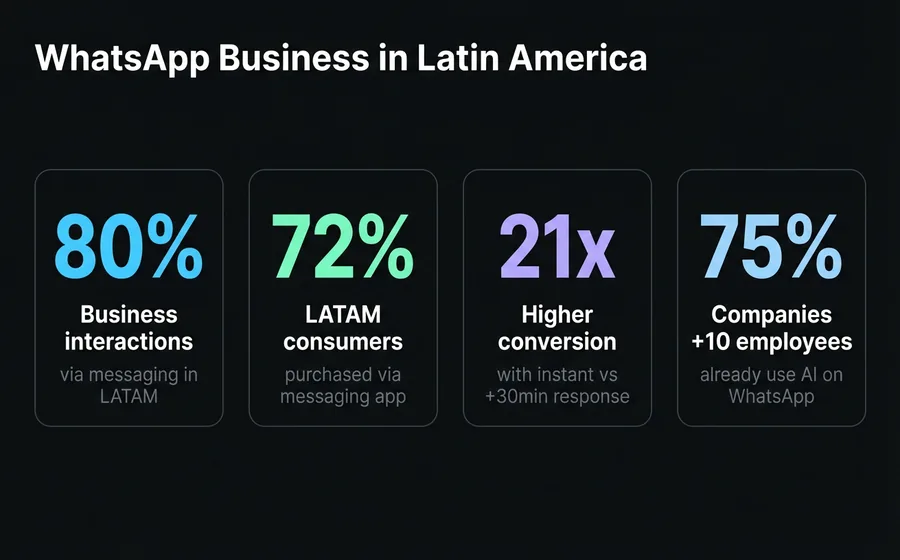
- 80% of the first commercial interactions in LATAM occur via messaging
- 72% of Latin American consumers have made at least one purchase through a messaging app (vs. 45% in Europe and 38% in North America)
- The adoption of WhatsApp Business API grew among 54% and 133% in 2023, depending on company size
- 75% of companies with more than 10 employees already use conversational AI on WhatsApp
This creates a unique opportunity. While in the United States or Europe companies distribute their AI across email, web chat, phone, and social media, in LATAM they can concentrate all their investment in a single channel where 80% of the conversation already takes place.
The integration of GPT with WhatsApp Business API allows a bot to understand a voice message (by transcribing it), process an image (an invoice, a proof of payment, a photo of a damaged product), and respond in the same thread with full historical context.
Chile leads the adoption of the WhatsApp Business API among medium and large companies in the region, with banks and retailers implementing AI Agents for 24/7 service. But the trend is rapidly expanding in Argentina, Colombia, Mexico, and Brazil.
The most revealing data point: companies that implement AI Agents on WhatsApp achieve conversion rates up to 21 times higher than those that take more than 30 minutes to respond. It's not just operational efficiency — it's a direct impact on revenue.
Trend 3: Copilots — AI that assists the agent, not replaces them
The narrative of "AI will replace human agents" sold headlines but does not reflect reality. According to Gartner, 95% of customer service leaders plan to keep human agents in their operations. What changes is how they work.
The model that is gaining traction is the copilot: an AI that works alongside the human agent, not instead of them.
An internal copilot does three things that transform team productivity:
1. Suggests real-time responses. The agent receives a complex query and, instead of searching a 200-page manual, the copilot suggests the correct answer based on the company's knowledge base. The agent reviews, adjusts if needed, and sends.
2. Consults external systems without leaving the chat. Does the customer ask about their order status? The copilot connects with the CRM or ERP, retrieves the information, and presents it to the agent in the same panel. Without switching tabs, without copying and pasting.
3. Analyzes the conversation and detects opportunities. If the customer mentions they are evaluating an upgrade or have a recurring problem, the copilot flags it to the agent with a suggested action: offer a superior plan, escalate to a specialist, or apply a retention discount.
McKinsey documented a case with 5,000 customer service agents where generative AI produced a 14% increase in query resolution per hour and a 9% reduction in handling timeThe potential for cost reduction per function is 30% to 45%.
But the most significant impact is not in the metrics: it's in team retention. Agents working with a copilot report feeling more secure and supported, which reduces turnover — a chronic problem in contact centers where turnover exceeds 30% annually.
58% of service leaders plan to reskill agents into knowledge management specialists, according to Gartner. It's not about reducing the team — it's about elevating their role.
Trend 4: Autonomous AI Agents Resolve Without Human Intervention
If copilots are AI as an assistant, autonomous agents are AI as an independent operator. It is the most ambitious trend for 2026 and the one that will have the most impact in the next 3 years.
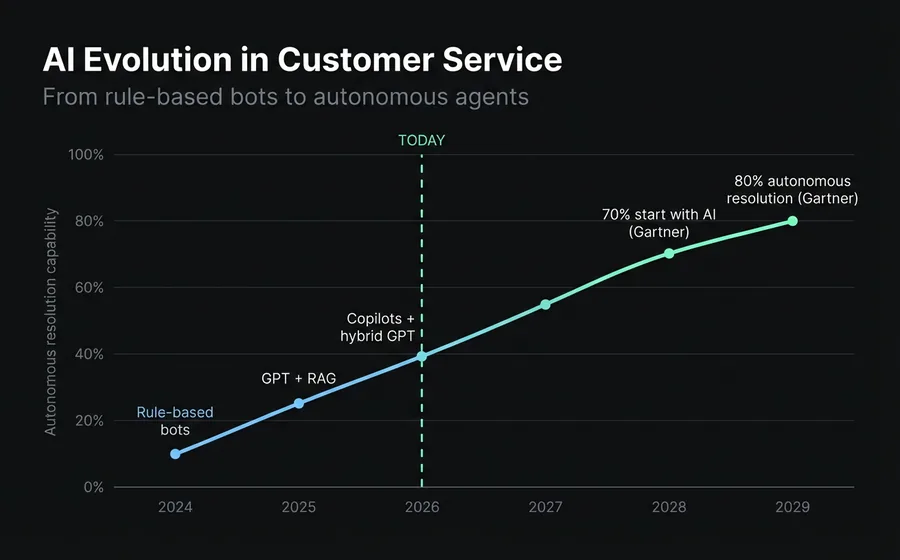
Gartner predicts that by 2029, agentic AI will autonomously resolve the 80% of common customer service problems without human intervention, generating a 30% reduction in operational costs.
What differentiates an autonomous agent from an AI Agent with GPT? The ability to act, not just respond.
An AI Agent understands the question and generates a response. An autonomous AI agent understands the question, consults the necessary systems, executes actions (modify an order, schedule a shipment, apply a refund), and confirms the resolution to the customer. All without human intervention.
On WhatsApp, this manifests in bots that can:
- Receive a photo of an invoice, extract the data with computer vision, and register the payment in the system
- Validate the customer's identity against an external API, generate a personalized payment link, and send the receipt upon processing
- Diagnose a technical problem step-by-step, execute available remote solutions, and only transfer to a human if the problem is not resolved
Today we are in the initial phase. Most companies in LATAM are using AI Agents (trend 1) or copilots (trend 3). Autonomous agents still require deep integration with internal systems and well-defined escalation protocols.
But organizations that start building that infrastructure now — robust knowledge bases, API integrations with their core systems, and clear escalation flows — will be the ones to capture the competitive advantage when the technology matures.
Trend 5: RAG and Proprietary Knowledge Bases Replace Generic GPT
Connecting a generic GPT to WhatsApp and letting it respond produces a bot that sounds intelligent but says anything. It can invent policies that don't exist, promise deadlines that the company doesn't meet, or provide information from a competitor as if it were its own.
The solution is called RAG (Retrieval-Augmented Generation): instead of the model responding from its general knowledge, it first searches your specific knowledge base and generates the response based exclusively on that information.
This transforms the reliability of the AI Agent. With RAG:
- The bot only says what your company has documented
- If it doesn't have the information, it admits it and transfers to a human
- It updates instantly when you change a document, a pricing policy, or a procedures manual
- It can be fed with PDFs, web pages, previous conversations, and internal documentation
The difference between a generic GPT and a GPT with RAG is the difference between an intern who improvises and a specialist who consults the manual before answering. Both use natural language, but only one is reliable to represent your company.
The hidden prompts complement RAG by defining the bot's personality, limits, and procedures. A hidden prompt can instruct the bot to never give pricing information if it doesn't have updated data, to always ask for the order number before giving a status, or to detect customer frustration and transfer to a human agent.
The combination of RAG + hidden prompts + integration with external systems is what separates an experimental AI Agent from a production tool that handles thousands of conversations per month.
These 5 trends are not independent — they reinforce each other. A company that implements only one captures partial value. The combination is where the exponential impact lies.
If today you use a rules-based chatbot on WhatsApp
, the first step is to add a GPT layer with RAG for queries that your current bot doesn't resolve. You don't need to replace the entire flow — you need to complement it. Transactional processes (schedule appointment, check balance, view order status) remain with the flow bot. Open-ended questions, complaints, and complex queries go to the GPT.If you already use GPT but without your own knowledge base
, you are exposing your company to invented answers. Building the knowledge base is the priority: upload your manuals, your FAQs, your service policies. Every document you feed reduces hallucinations and increases the first-interaction resolution rate.If you have a team of human agents
, an internal copilot reduces response time and increases quality without modifying your workflow. The agent continues to serve — but with an assistant that brings them the correct information instantly.For companies in LATAM, the channel advantage is real.
While competitors in other regions must implement AI across 5 simultaneous channels, in our region 80% of the conversation is on WhatsApp. This means that your investment in conversational AI is concentrated, your team specializes in one channel, and results are measured in a single flow. Less complexity, greater impact. McKinsey estimates that generative AI can reduce contacts requiring human attention by up to
in sectors such as banking, telecommunications, and utilities. But that number is only achieved with implementations that combine RAG, copilots, and well-designed escalation flows — not with a GPT connected to WhatsApp without configuration. 50% Predictions 2027
Based on current trajectory and Gartner data:
1. 70% of customers will start their service experience with a conversational AI interface
(Gartner, prediction for 2028 — in LATAM, due to WhatsApp penetration, this will be brought forward to 2027). 2. GPT chatbots with RAG will surpass flow chatbots in resolution rate
2. AI Agents with RAG will surpass flow-based chatbots in resolution rate 3. Internal copilots will be standard in teams of more than 10 agents.
The 14-30% productivity documented by McKinsey is too significant for operations directors to ignore, especially in contexts of cost pressure. 4. Companies that do not implement conversational AI on WhatsApp will lose market share
4. Companies that do not implement conversational AI on WhatsApp will lose market share against competitors who respond in seconds with accurate information. In a market where 72% of consumers already buy via messaging, response speed is a direct competitive differentiator.
Frequently asked questions
What is the difference between a rules-based chatbot and a GPT chatbot?
A rule-based chatbot follows predefined paths: the user chooses options from a menu, and the bot responds with programmed texts. An AI Agent understands natural language, generates dynamic responses, and can resolve queries that were never explicitly programmed, provided it has access to a relevant knowledge base.
Is it safe to use GPT to serve customers via WhatsApp?
Yes, as long as you implement RAG (so the bot responds only with verified information from your company) and hidden prompts (to define clear limits of what it can and cannot say). Without these layers, a generic GPT can invent information. With them, the bot is more consistent than a new human agent without training.
Will generative AI Agents replace human agents?
Not in the short term. 95% of customer service leaders plan to keep human agents, according to Gartner. What changes is their role: from answering repetitive questions to handling complex cases, managing knowledge, and supervising the quality of AI responses. The most effective model is the copilot, where AI assists the human.
How much does it cost to implement an AI Agent on WhatsApp?
The cost varies by scale, but the main investment is not technological — it's building the knowledge base. The technical setup (connecting GPT to WhatsApp Business API, designing prompts, integrating with internal systems) is done once. The real value is built in the following weeks, as you feed the knowledge base with specific information about your operation.
What results can I expect in the first 90 days?
Companies that implement AI Agents on WhatsApp see measurable results within the first few weeks: reduction in first response time to seconds (vs. minutes or hours), increase in first interaction resolution rate, and freeing up human agents for more complex cases. Full ROI typically materializes between 60 and 90 days, when the knowledge base is mature and escalation flows are optimized.
Conclusion
The 5 trends in this analysis — the transition to GPT, WhatsApp as an AI platform in LATAM, copilots for agents, autonomous agents, and RAG with proprietary knowledge bases — are not speculative predictions. They are technologies available today that the most competitive companies in the region are already implementing.
The question is not whether your company will adopt conversational AI on WhatsApp. It's how much ground your competitors will gain while you wait.
AsisteClick integrates GPT with proprietary knowledge bases, an internal copilot for agents, and omnichannel support — including WhatsApp Business API — in a single platform designed for companies in Latin America. Explore plans.