
A buyer finds your listing on a portal at 10:40 PM, messages you «Is the 1-bedroom in Palermo still available?» and goes to sleep. If you don't reply within the next few minutes, that same buyer has already messaged three other listings. Tomorrow, when you open the office and see the message, they've already booked a showing with the agency a block away. You didn't lose the deal on price or on the property: you lost it on speed.
That's the core problem that WhatsApp for real estate agencies solves when you combine it with an AI Agent: responding instantly, qualifying the prospect, booking the showing and following up, no matter the time or how many inquiries come in at once. In real estate the property is perishable —it gets rented, sold, dropped in price— and response time is the variable that moves the needle the most. According to the classic *Lead Response Management* study by Harvard Business Review and MIT, contacting a lead within the first 5 minutes makes you roughly 21x more likely to qualify it than if you wait 30 minutes, and nearly 100x more likely to even make contact.
This guide is for owners and sales managers of real estate agencies and brokers in LATAM who already use WhatsApp all day, but manually and in a disorganized way. You'll see, step by step, how to turn that chaos into a system: which jobs to delegate to an AI Agent, how to qualify leads automatically, how to book showings and cut no-shows, how to reactivate cold leads and how to unify portals, social media and your CRM into a single inbox. With tables, concrete criteria and real metrics.
Why WhatsApp is the real estate channel in LATAM
In the region, real estate contact doesn't start with a web form or a phone call: it starts with WhatsApp. The prospect sees the property on a portal or on social media, taps the contact button and the conversation lands in your WhatsApp. It's the channel where the customer already lives, where they open messages and where they expect an immediate reply, not an email they'll read two days from now.
Three traits make WhatsApp the natural channel for the sector:
- Extremely high open rate. WhatsApp messages are opened at a far higher rate than email, and almost always within the first few minutes. For a business where momentum is everything, that matters.
- Rich conversation. On WhatsApp you can send the property listing, photos, a walkthrough video, the exact location with a pin and even a document with the floor plan. The prospect decides whether to visit without leaving the chat.
- Immediate two-way communication. The customer asks, you answer, you book. The whole cycle —from the first inquiry to confirming the showing— happens in the same window.
The problem isn't the channel: it's the operation behind it. A small agency runs WhatsApp from the personal phone of one or two agents. A mid-size one has several phones, each agent with their own number, with no visibility into who handled what. Messages overlap, inquiries go unanswered at night and on weekends —which is exactly when people search for properties— and no one knows how many leads were lost to silence. WhatsApp is the right channel; what's missing is the system.
That system starts by connecting your number to the WhatsApp Business API, which is what lets several agents and an AI Agent handle the same number simultaneously, with a unified history per contact. From there, everything that follows in this guide becomes possible.
The real problem: real estate speed-to-lead
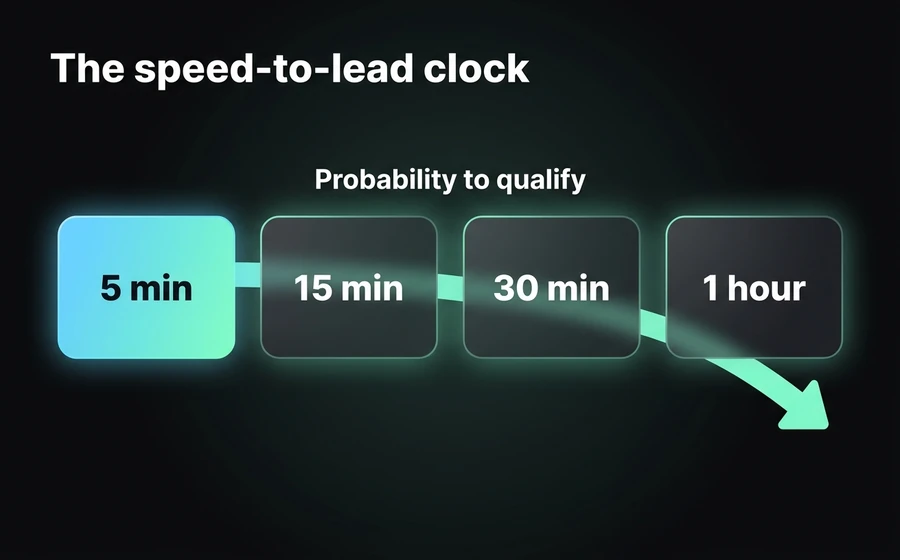
Speed-to-lead is the time between a prospect contacting you and you replying. In most sectors it matters; in real estate it's decisive, because the buyer or renter is inquiring about several properties at once and the decision on who to move forward with is made in the heat of the moment.
The numbers from the Harvard Business Review and MIT study are stark and they repeat themselves again and again in the real estate market:
- Contacting the lead within 5 minutes makes them roughly 21x more likely to qualify than contacting them at 30 minutes.
- The probability of even making contact drops nearly 100x between minute 5 and the half-hour mark.
- In real estate it's observed that around 78% of buyers work with the first agent who responds. The deal doesn't go to the best agent: it goes to the fastest one.
The reason is psychological. When someone sends an inquiry about a property, their head is «in real estate mode»: they're picturing the move, the investment, the change of life. They're ready to talk. Thirty minutes later they've cooked dinner, watched a show and their intent has dropped three notches. Two hours later they've already booked with someone else.
Here's the trap that almost no agency measures: the lead lost to slowness doesn't show up in any report. There's no box that says «deals lost by not responding in time». Those contacts simply never move forward, and it's assumed they «weren't that interested». The truth is that many of them were, but someone else responded first. We dig into this silent leak in our article on why WhatsApp leads get lost.
Instant human response, 24/7, is impossible to sustain: no team can reply in under 5 minutes at 11 PM on a Sunday. But an AI Agent can. And that's exactly the job it comes to do.
What an AI Agent does for a real estate agency
It's worth clarifying the terminology before going on. When we talk about an AI Agent we mean a conversational assistant powered by generative AI (GPT-style) that understands natural language, holds the context of the conversation and responds flexibly —not a rigid button menu. The prospect writes «I'm looking for a two-bedroom near a school, up to such-and-such amount» and the Agent understands it; it doesn't force them to pick option 1, 2 or 3.
A well-built AI Agent handles five concrete jobs for a real estate agency, all over WhatsApp and all instantly:
1. Respond 24/7, instantly
It's the most obvious job and the most profitable. The Agent handles every inquiry in seconds, at any hour, regardless of whether five simultaneous messages come in or fifty. It answers about availability, price, location, property features, rental requirements, costs, building fees. It captures that moment of peak intent that would otherwise cool off until the next morning.
2. Qualify the lead
Not everyone who writes is worth it. The Agent converses to understand what the prospect is looking for: area, budget, whether it's a purchase or rental, how many rooms, on what timeline they need to move. With that information it tags and prioritizes, so your human agents don't waste time with tire-kickers and focus on those ready to visit and close. We'll expand on this in the next section.
3. Book the showing
Once qualified, the Agent offers the prospect real available time slots from the relevant agent or branch, reserves the appointment and confirms it in the same chat. No back-and-forth of «does Tuesday at 4 work for you?», no busy phone line, no overlapping calendars.
4. Remind about the showing and cut the no-show
The no-show —the showing that's booked but doesn't happen— is wasted money and time: the agent went to the property and the customer didn't show up. The Agent sends automatic WhatsApp reminders before the appointment and lets prospects reschedule or cancel with a single tap, which drastically reduces no-shows.
5. Nurture and reactivate cold leads
Not every lead buys today. Many are «looking» for three months out. The Agent, together with mass messaging tools, keeps that contact alive: it notifies them when a property that matches what they wanted comes in, runs a scheduled follow-up and reactivates those who went lukewarm. We'll look at this in detail later on.
The beauty of delegating these five jobs is that your human team stops doing repetitive tasks (answering the same thing a hundred times, coordinating schedules, sending reminders) and focuses on what a human does best: closing the deal, negotiating, building trust during the showing. The Agent filters and prepares; the human closes.
How to qualify a real estate lead automatically
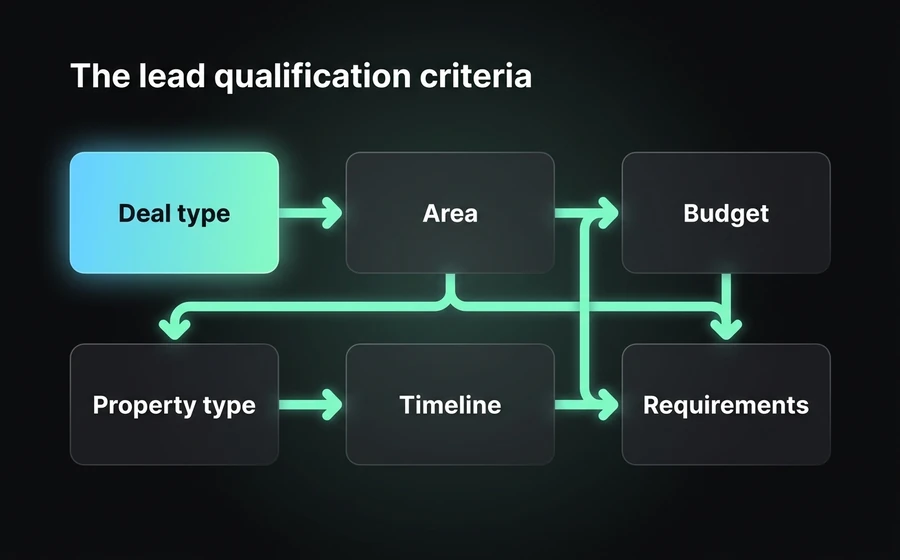
Qualification is where the AI Agent goes from «answering inquiries» to «growing the business». A well-qualified real estate lead has four dimensions the Agent can extract in a natural conversation of just a few messages, without it feeling like an interrogation.
The logic is simple: each dimension translates into a conversational question, and each answer triggers a concrete action from the bot. This is the criteria table worth having clear before configuring your Agent:
| Criterion | What the Agent finds out | Action it triggers |
|---|---|---|
| Operation | Purchase or rental? Looking to buy/rent, or wanting to sell/rent out their property? | Routes to the right portfolio (sale, rental, listing acquisition) and to the corresponding team. |
| Area | Neighborhood, city or area of interest. Proximity to schools, transit, work. | Filters available properties that match and discards those that don't apply. |
| Budget | Price range or monthly rent. Currency. Mortgage eligibility. | Tags the lead by ticket and filters properties within range. |
| Property type | Rooms, sq m, parking, professional use, pet-friendly, brand-new or pre-owned. | Refines the match and sends only relevant listings. |
| Timeline | Do they need to move this month or are they looking further ahead? | Prioritizes: hot lead (this month) → showing now; warm (3-6 months) → nurturing. |
| Requirements | For rental: guarantor, pay stub, pets. For purchase: payment method. | Pre-filters viability and avoids showings that won't go anywhere. |
The result of this qualification isn't an abstract score: it's an operational decision. A prospect looking to rent a 1-bedroom in an area where you have inventory, with a budget within range and who needs to move this month, is a hot lead that should go straight to booking a showing. A prospect who's «just looking» to buy next year is a nurturing lead worth keeping warm with follow-up, not burning out with sales pressure.
There's a key detail for this to work: qualification has to feel like a conversation, not a form. The generative AI Agent pulls this off because it can understand messy answers («it's for me and my partner, we have a dog, we're looking near Caballito for up to around 400k») and extract operation, property type, area and budget from a single message. A traditional button menu would force the customer through five screens; the Agent solves it in one exchange.
If you want to go deep into the mechanics of qualification —including how to apply BANT-style frameworks in just a few messages— we cover it in the guide on qualifying leads on WhatsApp with AI. And everything the Agent gathers —contact details, preferences, tags— is saved in the CRM, which is where this information becomes actionable. More on that in the unification section.
Booking showings via WhatsApp step by step
Booking is the point where the conversation turns into a concrete deal. If the prospect qualified as hot, the worst thing you can do is tell them «an advisor will contact you» and leave them waiting. The best thing is to book the showing on the spot, within the same chat. Here's how the flow works, step by step:
Step 1: The Agent offers real available time slots
When the lead is ready to visit, the Agent checks the real calendar of the human agent or branch and offers the prospect the open slots: «I have Thursday at 11, Thursday at 5 or Saturday at 10 available. Which works best for you?». It doesn't offer phantom slots: it reads real availability to avoid overlaps.
Step 2: The prospect chooses and the Agent reserves
The customer responds with their preference and the Agent blocks that slot in the calendar. The appointment is logged with the property, the assigned agent, the date and the prospect's details, all without human intervention.
Step 3: Immediate confirmation with all the details
The Agent confirms the showing in the chat with the exact address (location pin included), the time, the name of the agent who'll receive them and any instructions (which doorbell to ring, where to park). The prospect has everything in their WhatsApp, without having to look anything up.
Step 4: Handling multi-agent and multi-branch
If your agency has several agents or several branches, the system routes each showing to the right calendar. The agent in the north zone sees their showings; the one in the south zone, theirs. Each with their own availability, without clashing.
Step 5: Reminders that cut the no-show
Here's the differentiator. A booked showing is worthless if the customer doesn't show up. The system sends automatic WhatsApp reminders —typically the day before and a few hours ahead— and lets the prospect confirm, reschedule or cancel with one tap. This does two things: it reduces no-shows (the customer who can no longer make it lets you know instead of just not showing up) and it frees that slot for another prospect.
The impact of avoided no-shows hits team productivity directly. An agent who does five showings in a day and has two no-shows lost 40% of their field time. Bringing that down to 10% is, in practice, recovering an agent and a half of capacity without hiring anyone.
All of this runs on the online schedulingmodule, which is what connects the conversational Agent to the team's real calendars. If you want to compare approaches to managing appointments via WhatsApp, we have a dedicated guide on the online appointment scheduler via WhatsApp.
Reactivating cold leads and following up
A good part of a real estate agency's value isn't in today's leads, but in the accumulated base of people who inquired at some point and didn't close. That list is usually dead: nobody works it because doing it by hand is unfeasible. Reactivating it is where WhatsApp mass messaging becomes a low-cost deal-generating machine.
The difference between spam and effective reactivation lies in segmentation. You don't send «we have properties» to the whole base: you use the data the Agent has been saving (area, budget, property type, operation) to send the right message to the right person. Some triggers that work in real estate:
- New property match. A 2-bedroom came into Villa Urquiza within the range that segment was looking for → a targeted message only to those who fit.
- Price change. A property's price dropped → notify the prospects who had inquired about it and found it expensive.
- Timeline reactivation. Three months have passed since a lead said «I'm looking further ahead» → a follow-up message to re-engage.
- Deal closing. After a purchase or rental, a satisfaction follow-up and a referral request —word of mouth is gold in this sector.
The key is that these messages aren't a blind broadcast: each campaign is triggered against a defined segment, with a personalized message, and the replies land back in the same inbox where the Agent can pick up the conversation, re-qualify and book again. The cycle closes itself.
This is managed with Wadalio, the WhatsApp mass messaging tool, which lets you import contacts, segment, schedule campaigns and measure results while respecting Meta's rules so you don't put the number at risk. The combination —an AI Agent that captures and qualifies live + mass messaging that reactivates the base— is what turns a reactive agency into a proactive one.
Unifying portals, social media and CRM into a single inbox
So far we've talked about WhatsApp, but a real estate agency's leads don't come in only through there. They come in through the property portals, through Instagram when someone comments on a story about a property, through Facebook Marketplace, through the website's own chat. The most common mistake is handling each channel separately: one person watches the portal messages, another the Instagram, another the WhatsApp. The result: the same prospect writes through two channels, gets two different answers from two different people, and the experience is a mess.
The solution is omnichannel: having all those channels land in a single inbox, with the same AI Agent handling them and a unified history per contact. If a prospect inquired via Instagram on Monday and comes back via WhatsApp on Thursday, the system knows it's the same person and picks up where it left off, instead of making them start from scratch.
| Entry channel | Typical lead source | What the unified inbox solves |
|---|---|---|
| Contact button on portals and in the classified listing. | Instant 24/7 response, qualification and booking in the same chat. | |
| DM or comment on a story/post about a property. | The Agent replies to the DM and, if it makes sense, moves the conversation to WhatsApp. | |
| Messenger and Marketplace. | Same Agent, same qualification, without the lead getting lost in a separate inbox. | |
| Webchat | Chat on the agency's own website. | Captures the anonymous visitor's inquiry and turns it into a contact. |
But unifying the conversation is only half of it. The other half is that every prospect becomes a live record in the CRM. When the Agent qualifies a lead, it doesn't just tag the chat: it creates or updates the contact in the CRM with their area, budget, property type sought and timeline. Every property inquired about, every showing booked and every interaction stays on the contact's timeline. Deals move through a visual kanban-style pipeline —from «new lead» to «showing booked» to «in negotiation» to «closed»— where the team sees at a glance what stage each prospect is in and who owns each deal.
This changes how the team is managed. A sales manager stops asking «how's it going with your clients?» and starts looking at the board: how many new leads came in this week, how many showings were booked, how many deals are stalled and where. Management stops relying on each agent's memory and starts relying on data. We cover this architecture in depth in the article on conversational CRM for WhatsApp, and all of this lives in the AsisteCRM module integrated into the inbox.
The metrics that matter
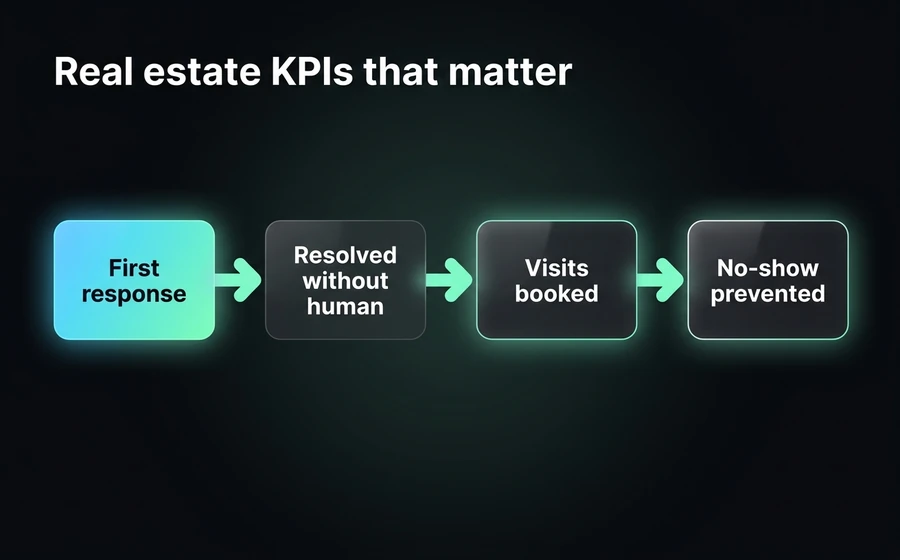
If you don't measure, you don't know whether the system works or where the leak is. The good news is that, once WhatsApp and the AI Agent are centralized, the metrics generate themselves. These are the ones a real estate agency should review every week:
| Metric | What it measures | Why it matters in real estate |
|---|---|---|
| First response time | How long the first message takes to be answered. | It's the speed-to-lead metric. With an AI Agent it should be seconds, 24/7. |
| % resolved without a human | Conversations the Agent closes on its own (inquiry + qualification + booking). | Measures how much repetitive work you took off the team's plate. |
| Qualified leads | How many contacts passed the filter and entered the pipeline as an opportunity. | Separates the volume of inquiries from the volume of real opportunities. |
| Booked showings | Appointments reserved through the chat, by agent and by branch. | It's the leading indicator of future deals. |
| No-show rate | % of booked showings that don't happen. | Every no-show is lost field time. Reminders bring it down. |
| Reactivated leads | Cold contacts that came back to converse after a campaign. | Measures how much value you extract from the accumulated base, at almost no cost. |
| Deal conversion rate | From lead to showing, from showing to reservation, from reservation to close. | The full funnel. Shows where people drop off and where to optimize. |
A practical recommendation: don't try to optimize everything at once. Start with first response time (the one that impacts the most, per the speed-to-lead data) and with the no-show rate (the one that recovers the most money in the short term). Once those two are under control, look at funnel conversion to see where to reinforce the human team. The advantage of having everything on a single platform is that these numbers don't have to be assembled by hand in a spreadsheet: they come straight out of the system, live.
A real speed-to-lead case
The speed-to-lead problem isn't theoretical, and it's not only real estate agencies that suffer from it: it's every company that serves the real estate and construction sector. New Leaf Cleaning Services, a Canadian cleaning company based in Saskatoon, is a good example. Its strongest vertical is post-construction deep cleaning for the growing Canadian real estate market: when a builder finishes new construction, they need professional cleaning before handing it over. It's a time-sensitive sector identical to a real estate agency's —whoever responds first wins the job.
When Mariana Barreto Prieto took over running New Leaf, she inherited a manual operation where inquiries were scattered across personal WhatsApp accounts, calendars overlapped and opportunities slipped away daily. The description of the problem is almost word-for-word that of a real estate agency losing deals to slowness:
«We were losing clients not because of the quality of our work, but because we couldn't respond fast enough. A builder would send us a request and, by the time we saw it, they'd already hired another company.»
Mariana Barreto Prieto, Manager of New Leaf Cleaning Services
That's speed-to-lead in its purest form. The job wasn't lost on price or quality: it was lost because someone responded sooner. The solution was to deploy an AI Agent with GPT on WhatsApp that responded instantly, qualified the request and booked, 24/7. The published results:
- 65% to 80% of conversations resolved automatically, without human intervention.
- Between 2 and 4 hours of human work saved per day.
- 24/7 scheduling, capturing requests that used to cool off after hours.
The lesson for any real estate agency is direct: the bottleneck is almost never the quality of the property or the service. It's response speed. You can read the full story in the New Leaf case.
How to implement it with AsisteClick
At this point, the question stops being «is it worth it?» and becomes «how do I set it up without it turning into a months-long project?». This is where the approach matters. There are two paths to get an AI Agent on WhatsApp up and running in a real estate agency:
The first is the self-servicepath: you hire a tool, they give you a bot builder and you figure it out on your own to configure the qualification, connect the calendars, write the Agent's prompts, load the property information and test everything. It works if you have a technical profile and time. For most real estate agencies, it doesn't.
The second —and the one that sets AsisteClickapart— is the managed service: our team builds and implements the AI Agent with you. That includes designing the qualification flow based on your portfolio, connecting your WhatsApp Business API, integrating your agents' and branches' calendars, loading the property information so the Agent answers accurately, configuring the reminders and leaving the CRM hooked up. You handle selling properties; we handle the system. It's the difference between buying tools and receiving a working solution.
The stack assembled for a real estate agency combines the pieces we saw throughout the guide:
- AI Agent with GPT on WhatsApp, Instagram, Facebook and webchat, responding and qualifying 24/7.
- Online scheduling connected to the team's real calendars, multi-agent and multi-branch, with automatic reminders.
- CRM with a kanban pipeline, automatic lead qualification, engagement score and a timeline per contact.
- Mass messaging to reactivate the base of cold leads and nurture those who buy further down the line.
- Omnichannel inbox that unifies all channels and the entire history in one place.
The important thing is that you don't need to change how your team works overnight. The AI Agent takes the front line —responding, qualifying, booking, reminding— and your human agents receive already-qualified leads with the showing booked. You start with what hurts most (slow response and no-shows) and keep adding layers.
If you want to see how this would look applied to your agency, request a demo and we'll build the Agent with your properties, your areas and your calendar. The first deal you recover by responding in time, instead of losing it to silence, pays for the system.
Frequently asked questions
Do I need the WhatsApp Business API to automate my real estate agency?
Yes, you need the WhatsApp Business API so that several agents and an AI Agent can handle the same number at the same time with a unified history. The regular WhatsApp Business app is designed for a single device and doesn't allow connecting an AI Agent professionally or maintaining team visibility. The API solves that and is the first step of any serious implementation. At AsisteClick we manage the connection for you as part of onboarding.
Can the AI Agent book showings in each agent's real calendar?
Yes, the Agent reads the real availability of each agent or branch and offers only the open slots, avoiding overlaps. When the prospect chooses, it reserves the appointment, confirms it in the chat with the address and details, and routes the showing to the right calendar based on the area or assigned agent. It then sends automatic reminders to reduce no-shows.
Does an AI Agent replace my real estate agents?
No, the AI Agent doesn't replace your agents: it takes the repetitive work off their plate so they can focus on closing. The Agent responds instantly, qualifies and books; your human agents receive already-filtered leads with the showing coordinated and dedicate themselves to the showing, the negotiation and the close, which is where the human factor makes the difference. The combination performs better than either one on its own.
How does the Agent qualify a prospect without it feeling like an interrogation?
The Agent qualifies by conversing in natural language, not with a button form. It extracts operation, area, budget, property type and timeline from messy answers —even from a single message— because it uses generative AI that understands context. The prospect feels like they're talking to someone who gets them, while the system tags and prioritizes the lead behind the scenes.
Is it useful for a small real estate agency or only for big ones?
It's useful for both, and often the relative impact is greater for the small ones. A small agency with one or two agents is precisely the one that can't respond at 11 PM on a Sunday or follow up with its entire base; that's where the AI Agent acts as a sales assistant that never sleeps. The implementation is the same and adapts to the size of the portfolio and the team.
What about leads coming in through real estate portals and social media?
All those leads are unified into a single inbox alongside the WhatsApp ones. Portal inquiries, Instagram DMs, Facebook messages and the website chat all land in the same place, handled by the same AI Agent and with a unified history per contact. So if a prospect writes through two different channels, the system knows it's the same person and doesn't make them start from scratch or give them contradictory answers.
Conclusion
In real estate, the deal goes to whoever responds first, not necessarily to whoever has the best property. The Harvard Business Review and MIT study quantifies it —responding within 5 minutes makes you up to 21x more likely to qualify the lead— and the market confirms it: most buyers work with the first agent who answers. Sustaining that speed manually, 24/7, is impossible for any human team.
WhatsApp for real estate agencies, combined with an AI Agent, solves exactly that problem: it responds instantly at any hour, qualifies the prospect by area, budget, operation and timeline, books the showing in the agent's real calendar, cuts no-shows with reminders and reactivates the base of cold leads. And all of it unified in a single inbox with the CRM hooked up, so management stops depending on each agent's memory and starts relying on data.
If your real estate agency is losing deals that don't show up in any report —because they fall through in silence after hours— that's the most expensive problem and the easiest one to solve. Talk to our team and we'll build the Agent with your portfolio, your areas and your calendar.