
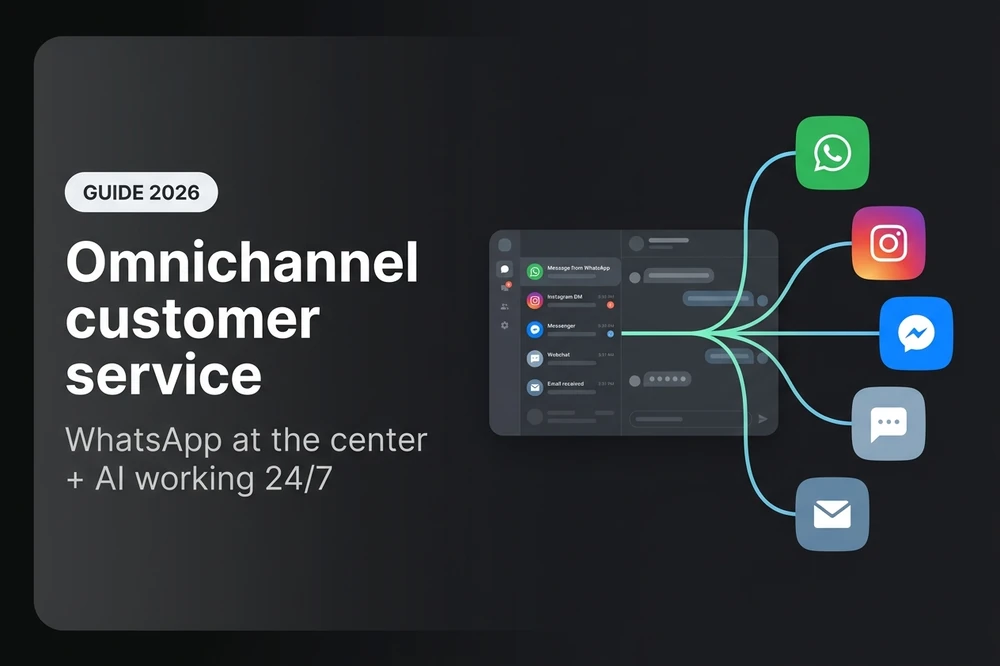
Your customer messages you on WhatsApp on Monday, comments on your Instagram on Tuesday and on Wednesday sends you an email asking the same thing. In most companies, those three interactions land in three different inboxes, are handled by three different people and none of them knows what the other two said. The customer has to repeat their problem from scratch every time. That —exactly that— is what omnichannel customer service is here to solve.
In this guide you'll understand what omnichannel really means (and why it's not the same as having many channels), why in Latin America every serious omnichannel strategy starts with WhatsApp, which channels you should unify, how an omnichannel platform works under the hood, what role AI plays and how to implement it step by step without rebuilding your entire operation. With concrete data, real examples and the metrics you should be watching.
What omnichannel customer service is
Omnichannel customer service is a strategy that integrates all of a company's communication channels into a single system, so that the customer experiences one continuous conversation no matter where they reach you. History, context and data travel with the customer from one channel to another.
The key word is continuity. In an omnichannel model, if a person starts an inquiry on your website chat and continues it on WhatsApp two hours later, the agent handling it sees everything that happened before: what they asked, what they were told, what documents they attached, where the conversation left off. The customer repeats nothing and the company loses no context.
This changes the very nature of support work. Instead of managing "WhatsApp tickets," "Instagram tickets" and "email tickets" as if they were separate universes, you manage people with a unified history. The channel becomes a detail —the medium a message came in through— and not a border that splits information into pieces.
Omnichannel done right has three properties worth being clear about from the start:
- A single source of truth per customer. All of their interactions, across all channels, are consolidated into a single profile and a single timeline.
- Context continuity across channels. Switching channels doesn't reset the conversation; it carries it along.
- Consistency of experience. The tone, response times and quality of service are the same regardless of the channel.
When a company achieves those three things, it stops "answering messages" and starts sustaining relationships. And that shows up in retention: according to a classic Aberdeen Group study, companies with a strong omnichannel strategy retain on average 89% of their customers, versus just 33% for those with weak omnichannel.
Omnichannel vs multichannel: the difference that changes everything
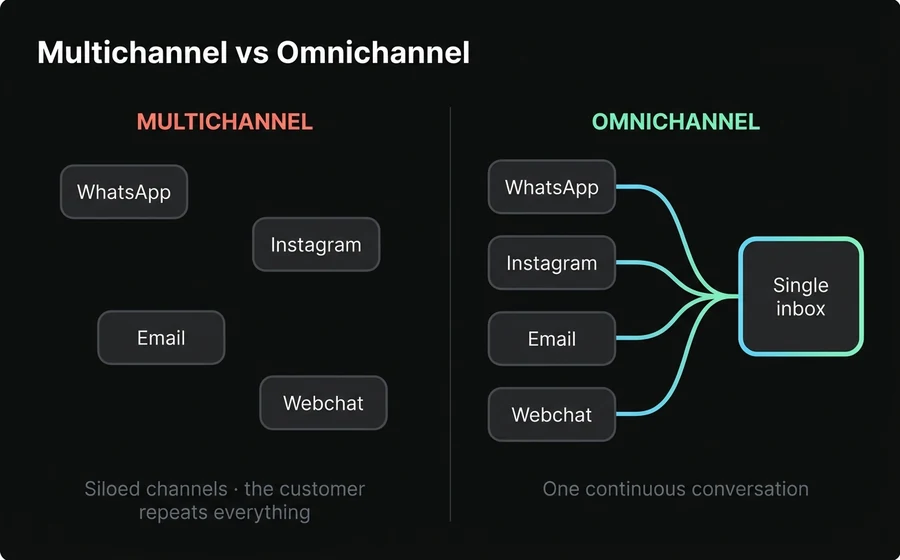
Multichannel means being present on several channels. Omnichannel means those channels are integrated with each other and share context. The difference isn't semantic: it defines whether your customer experiences something seamless or fragmented.
Almost every company today is multichannel without knowing it: they have WhatsApp, a Facebook page, an email inbox, maybe Instagram. The problem is that each channel lives in its own application, is handled by a different person and the information never crosses over. The customer feels they're talking to disconnected "departments," not to one company.
Omnichannel breaks down those silos. Here's the difference, side by side:
| Dimension | Multichannel | Omnichannel |
|---|---|---|
| Channels | Several, but isolated | Several, integrated into one system |
| Customer context | Lost when switching channels | Travels with the customer across channels |
| Inbox | One per channel (separate apps) | A single, unified one |
| The customer repeats their problem | Yes, on every channel | No, the history is available |
| Agent's view | Fragmented by channel | Single profile with full timeline |
| Metrics | Per channel, hard to consolidate | Centralized and comparable |
| Perceived experience | "I'm talking to different departments" | "I'm talking to one company" |
The practical consequence is huge. In a multichannel model, adding a channel adds work: one more inbox to watch, one more person to coordinate, more chances of something slipping through. In an omnichannel model, adding a channel adds reach without adding chaos, because it enters the same inbox with the same rules.
That's why the leap from multichannel to omnichannel isn't "having more channels," but unifying the ones you already have. Most companies don't need to be in more places; they need to stop handling them separately.
5 signs your customer service needs to go omnichannel
If you recognize three or more of these signs, your operation is already paying the cost of fragmentation —in lost customers, in your team's time and in sales that don't close.
- Your customers repeat their problem every time they switch channels. It's the clearest symptom. If someone messaged you on Instagram and, on moving to WhatsApp, has to explain everything again, you don't have omnichannel.
- Each channel is handled by a different person with a different app. Your team jumps between the WhatsApp app, the Instagram inbox, the email account and the website chat. No one has the full picture of a customer.
- You don't know how many open conversations you have right now. If someone asks how many customers are waiting for a reply right now, across all channels, and you can't answer, you have no visibility into your operation.
- Messages slip through the cracks. Inquiries that go unanswered because they came in through a channel no one was watching. Each one is a lead or a customer who leaves feeling ignored.
- You can't measure your service in a consolidated way. You have scattered metrics per channel —if you have them at all— but you can't answer basic questions like "what's our overall first response time?".
These signs have something in common: they aren't "lack of channels" problems, they're problems of lack of integration. The solution isn't to open one more channel, but to unify the ones you already have.
Why in LATAM every omnichannel strategy starts with WhatsApp
In Latin America, WhatsApp isn't just another channel: it's the channel. Any omnichannel strategy that doesn't put it at the center is building on the wrong foundation. Meta reports that more than 175 million people message businesses on WhatsApp every day worldwide, and in markets like Argentina, Mexico, Brazil or Colombia the app's penetration surpasses email and phone as the preferred channel for communicating with a business.
This has a strategic implication that platforms designed for the United States or Europe tend to ignore: over there omnichannel revolves around phone and email; here it revolves around messaging. Traditional enterprise suites were born centered on the call center —voice as the backbone— and added chat and messaging as accessories. In LATAM the correct architecture is the reverse: WhatsApp as the main channel, with the rest orbiting around it.
The reason WhatsApp works so well as the omnichannel hub is that it's asynchronous by nature. Unlike a call, which requires both parties to be present at the same time, a WhatsApp conversation can be paused and resumed hours or days later without losing the thread. The customer asks at 10, has lunch, comes back at 2 p.m. and picks up where they left off. That same asynchronous property is what lets a single agent handle several conversations in parallel and lets AI handle the repetitive stuff at any hour.
But WhatsApp alone isn't enough. Some of your customers will find you first on Instagram, others will comment on Facebook, others will come in through your website chat and some —especially in B2B— will keep preferring email. The mistake is handling each one on its own island. The right strategy is to use WhatsApp as the highest-volume channel and unify all the others in the same inbox, so that a customer who messaged you on Instagram and then reached out on WhatsApp is one conversation, not two. (If you want to dig into why so many businesses lose sales by not responding in time on these channels, we cover it in why WhatsApp leads get lost.)
The channels you need to unify
A modern omnichannel operation in LATAM usually combines between five and eight channels. Not all apply to every business, but it's worth mapping them to decide which to unify first. These are the ones a serious omnichannel platform should be able to centralize:
- WhatsApp Business API. The highest-volume channel. Not the regular app, but Meta's official API, which allows multiple agents on a single number, automation with bots and template sending. It's the backbone of the operation.
- Instagram Direct. Where customers who arrive through content and advertising find you. Direct messages and story replies land in the same inbox.
- Facebook Messenger. Still relevant in many segments, especially for adult audiences and local businesses.
- Telegram. Lower volume, but key in technical niches and communities. Useful as a 24/7 support channel.
- Webchat. The chat embedded in your site, ideal for capturing the visitor at the moment of highest purchase intent.
- Email. Indispensable in B2B and for formal conversations or those with large attachments.
- Microsoft Teams. For internal support or employee service in large organizations.
- Video chat. For cases that require face-to-face contact: consultative sales, high-value support, onboarding.
There's a technical distinction worth not overlooking: the WhatsApp channel in a serious omnichannel operation isn't the regular app installed on a phone, but WhatsApp Business API, Meta's official version for businesses. It's what allows several agents to handle a single number, a bot to automate replies and approved templates to be sent. The regular app doesn't scale beyond one person and doesn't integrate with a support platform. That's why migrating to the API is usually the first technical step of any omnichannel project —and we cover it in detail in the WhatsApp for business guide.
The guiding principle isn't "be on all of them," but be where your customers are and unify them in one place. A clinic probably needs WhatsApp + webchat + Instagram; an ISP, WhatsApp + Facebook + Telegram; a B2B fintech, WhatsApp + email + Teams. What doesn't change is that all those channels have to flow into the same inbox, with the same history per customer.
How an omnichannel platform works under the hood
An omnichannel customer service platform is the system that makes the integration technically possible: it receives messages from all channels, consolidates them by customer and gives your team a single interface to respond. Under the hood, there are four pieces that work together.
1. The unified inbox. It's the heart of the system. All messages —whether they come from WhatsApp, Instagram, email or the website chat— arrive in a single inbox. The agent doesn't jump between applications: they see a list of conversations and, on opening each one, the channel it came in through is just a label. In AsisteClick this inbox is called AsisteChat and it centralizes all channels with a profile per contact and their full timeline.
2. Smart routing. Not every conversation needs to be seen by everyone. A good omnichannel system routes each message to the right agent or team based on rules: by channel, by type of inquiry, by language, by workload. A bot can greet the customer, understand what they need and route them to the right team with the context already loaded, so no one has to ask "how can I help you?" again.
3. Unified context. Every conversation carries the customer's history with it: previous interactions on any channel, their profile data and —if it's integrated with your CRM or management systems— business information like their account status, their purchases or their open tickets. This is what keeps a channel switch from resetting the conversation.
4. The real-time monitor. To coordinate an operation with multiple agents and multiple channels, you need to see what's happening right now: how many open conversations there are, which ones are unanswered, who's overloaded, where delays are piling up. The live monitor is what turns a chaotic inbox into a manageable operation.
There's a fifth element that separates serious omnichannel platforms from the rest: the integration with your business systems. The conversation context is valuable, but the business context is even more so. When the platform connects via API to your CRM, your ERP or your management system, the agent —and the AI agent— don't just see what the customer said before, but who they are: their account status, their orders, their open tickets, their purchase history. That's what lets the bot reply "your order #4821 ships tomorrow" instead of "check the status on our website." Omnichannel without data integration is half omnichannel.
The difference between a real omnichannel platform and a "channel aggregator" lies precisely in these pieces. Adding channels to the same screen is easy; what's hard —and what's valuable— is for them to share context, be routed with judgment, connect to your business data and be supervised as a single operation.
The role of AI in omnichannel
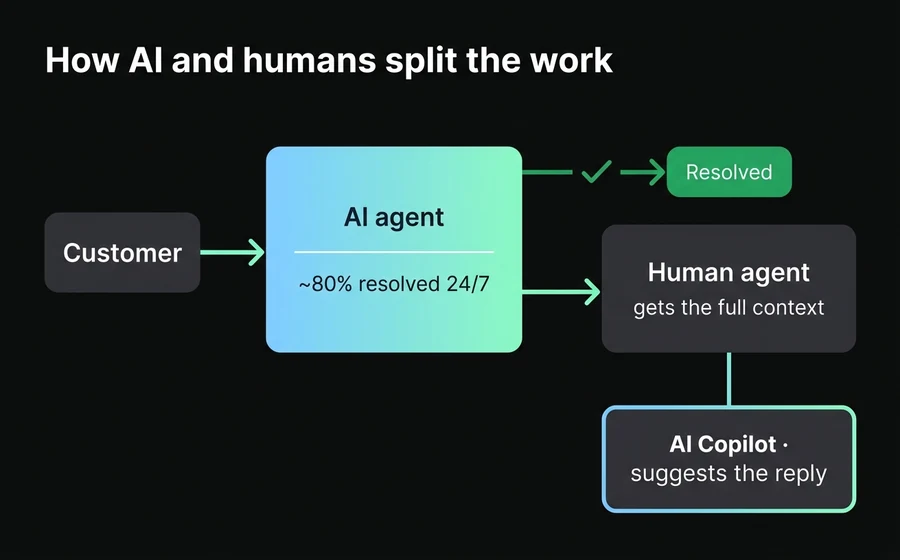
AI is what lets an omnichannel operation scale without growing the team in the same proportion as the messages. Its role isn't to replace human agents, but to absorb the repetitive work and empower people on what truly requires judgment. It works on three levels.
AI agents that handle support 24/7. An AI agent autonomously resolves frequent and transactional inquiries —hours, an order's status, product questions, simple tasks— on any channel and at any time. In a well-designed operation, it automates up to 80% of interactions, which frees the human team to focus on the cases that add value. The key is for the AI agent to know when it doesn't know: faced with a complex or sensitive inquiry, it escalates to a human with the full conversation context, without the customer having to start over.
Smart escalation to a human. The handoff from AI to agent is the most delicate moment of the experience. Done right, it's invisible: the customer continues the conversation and the human agent steps in already knowing what was discussed. Done wrong, it forces the customer to repeat everything and destroys trust. A serious omnichannel operation designs that handoff carefully —when it escalates, what context is passed, how the customer is notified.
Copilot for the human agent. While the agent responds, an AI copilot suggests the best reply in real time, with the conversation context and the company's knowledge base. The agent doesn't start from scratch or hunt for information on another screen: it's right there, ready to send or adjust. This raises speed and consistency without taking the human out of the equation. We explain how to implement it in the guide on real-time AI copilot for agents.
The golden rule is that AI in omnichannel customer service shouldn't try to answer everything. It should have a clear mission —resolving a certain type of inquiry within a bounded domain— and escalate the rest. The AI agents that fail are usually the ones that tried to cover too much without a process design behind them.
How to implement omnichannel customer service step by step
Moving from scattered channels to an omnichannel operation doesn't require rebuilding everything at once. It's a six-step process that's best tackled in order.
Step 1: Map your real channels. List where your customers message you today and with what volume. Don't assume: check the numbers. It's common to discover that 70% of the volume comes in through WhatsApp and that a channel you thought was important is barely used. That map defines your priorities.
Step 2: Unify WhatsApp first. If you're still using the regular WhatsApp app on a phone, the first leap is to migrate to WhatsApp Business API, which allows multiple agents on a single number and enables automation. It's the highest-impact change because it concentrates the bulk of the volume. (Here our team handles the number migration and the API setup, which is usually the most feared part of the process.)
Step 3: Connect the rest of the channels to the same inbox. Once WhatsApp is on the platform, add Instagram, Facebook, webchat and email to the same place. The goal is for the agent to stop jumping between applications. Start with the highest-volume channels and add the rest progressively.
Step 4: Define routing rules. Decide how each conversation is routed: which team handles what, how the load is distributed, when a bot steps in. Without clear rules, the unified inbox becomes a bottleneck. With them, every message reaches the right person.
Step 5: Add AI where the volume justifies it. Identify the most repetitive inquiries —the ones your team answers twenty times a day— and automate them with an AI agent. Start narrow: a clear domain, escalation to a human for everything else. To decide what information goes in the prompt, what goes in the knowledge base and what's queried in real time, our guide on the three knowledge layers of an AI agent.
Step 6: Measure and adjust. An omnichannel operation is managed with data. Define your metrics, watch the real-time monitor and adjust the rules, the bot flows and the staffing based on what you see. Omnichannel isn't a project that gets "finished"; it's an operation that gets fine-tuned.
The most common mistake is wanting to do all six steps at once. The implementation that works is incremental: you unify WhatsApp, stabilize, add a channel, stabilize, add AI where it hurts, measure. Each step delivers value on its own.
Omnichannel in action: how it looks across different sectors
Omnichannel doesn't look the same at a clinic as at a fintech. The strategy is the same —unify channels with WhatsApp at the center and AI for the repetitive work— but the channels, the flows and the metrics change depending on the business. These four examples show how it translates in practice.
Healthcare (clinics and practices). The volume concentrates on booking, rescheduling and reminding patients of appointments. A typical omnichannel operation combines WhatsApp (appointments and reminders), webchat (capturing the visitor on the site) and Instagram (where new patients arrive through content). The AI agent manages the schedule end to end and only escalates complex clinical or administrative cases to a human. The metric that moves the needle most is reducing appointment no-shows. We cover it in WhatsApp appointment scheduling for clinics.
Fintech and collections. Here the main channel is WhatsApp for payment reminders and payment links, with email as a formal backup in B2B. The AI agent sends staggered reminders based on the stage of delinquency, generates the payment link and logs the receipts, escalating complex negotiations to a human. Unified context is critical: the agent handling a negotiation needs to see the account status and the entire contact history. More detail in WhatsApp collections chatbot for fintech.
ISP and telecommunications. Technical support dominates the volume: outages, slowness, balance inquiries. An omnichannel operation here usually combines WhatsApp, Facebook (heavily used by the audience of regional ISPs) and Telegram. The AI agent does first-level diagnosis —connection tests, balance checks, ticket creation— and routes to a technician only what it can't resolve. We look at this in technical support chatbot for ISPs.
Ecommerce and retail. The customer moves between Instagram (where they discover), webchat (where they ask before buying) and WhatsApp (where they close the sale and follow up after purchase). Omnichannel lets the pre-sale conversation, the purchase and the post-sale claim be a single thread. The AI agent answers questions about stock, shipping and returns, and recovers sales that were left unfinished —a topic we address in recovering abandoned carts via WhatsApp.
The pattern is always the same: you identify the highest-volume channel (almost always WhatsApp), unify the rest around it and let AI absorb the bulk of each sector's repetitive work. What changes is the detail of the flow, not the architecture.
The metrics of an omnichannel operation
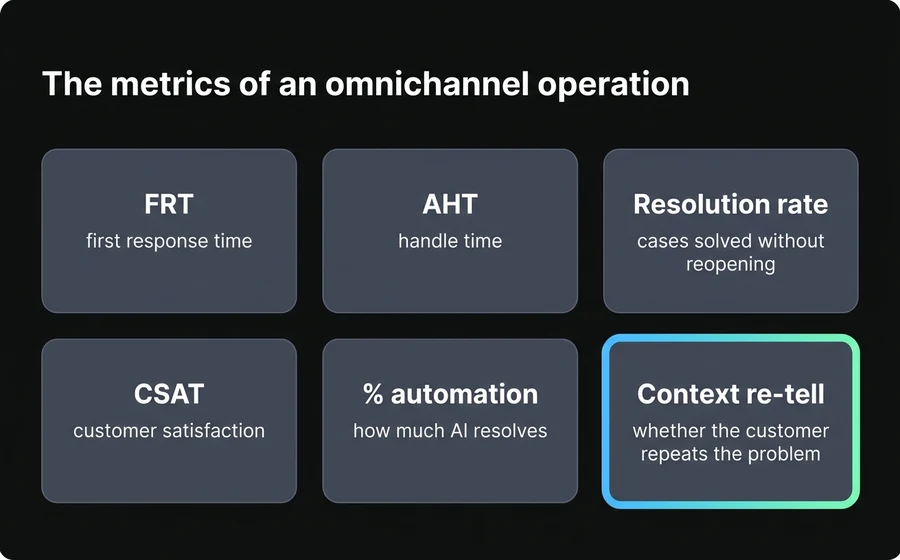
What isn't measured isn't managed. And in omnichannel, measuring is easier than in multichannel, precisely because everything is centralized. These are the metrics that matter:
| Metric | What it measures | Why it matters in omnichannel |
|---|---|---|
| FRT (First Response Time) | How long the first response takes | The strongest predictor of satisfaction; in messaging, the expectation is minutes |
| AHT (Average Handle Time) | Handling time per conversation | On asynchronous channels it has to be measured differently than on voice |
| Resolution rate | % of cases resolved without reopening | Measures real quality, not just speed |
| CSAT | Customer satisfaction | The thermometer of the perceived experience |
| % of automation | How much AI resolves without a human | Measures the efficiency you gain with AI agents |
| Context recovery rate | How many times the customer had to repeat their problem | The most omnichannel metric of all: it measures whether the integration works |
An important warning about AHT: in asynchronous messaging it isn't measured like a call. If you take the time between when a WhatsApp ticket is opened and closed, you'll inflate the number absurdly, because the customer can take hours to reply. AHT in messaging requires a formula adapted to the channel —we explain it in detail in AHT on WhatsApp: why the classic formula lies.
The metric most worth watching in a newly unified operation is the context recovery rate: if your customers still have to repeat their problem when switching channel or agent, omnichannel isn't working yet, no matter how many channels you have on one screen.
Common mistakes when building an omnichannel strategy
These are the most repeated stumbles —and how to avoid them.
- Confusing multichannel with omnichannel. The foundational mistake. Adding channels without integrating them isn't omnichannel: it's more scattered work. If adding a channel gives you one more inbox to watch, you're still in multichannel.
- Starting with too many channels at once. Trying to launch eight channels on day one guarantees that none of them work well. The implementation that works is incremental: WhatsApp first, then the rest.
- Automating without an escalation design. Putting in a bot that tries to answer everything and never routes to a human creates furious customers. AI has to know when to escalate, and do it with context.
- Treating AI as a replacement for the team. The best results come from combining AI agents for the repetitive work with humans —empowered by a copilot— for what requires judgment. Whoever replaces their entire team with bots ends up with worse service and customers who leave.
- Not measuring context recovery. It's the metric that reveals whether omnichannel really works, and almost no one looks at it. If the customer repeats their problem, you failed, even if the dashboard shows low response times.
- Choosing a voice-centric platform for a messaging market. In LATAM, adopting a suite designed for the U.S. call center means fighting against the tool's architecture. Better a WhatsApp-first platform.
Frequently asked questions
What's the difference between multichannel and omnichannel customer service?
The difference is integration. Multichannel means being on several channels that operate separately; omnichannel means those channels share context and history, so the customer experiences one continuous conversation even if they switch channels. In multichannel the customer repeats their problem on every channel; in omnichannel, they don't.
Do I need to be on every channel to be omnichannel?
No. Being omnichannel isn't about the number of channels, but about integrating the ones you already use. It's better to unify three channels well (for example WhatsApp, Instagram and webchat) than to have eight disconnected channels. Map where your customers message you and unify those.
Why is WhatsApp so important in an omnichannel strategy in LATAM?
Because in Latin America WhatsApp is the preferred channel for communicating with businesses, above email and phone. Meta reports more than 175 million people messaging businesses on WhatsApp every day. An omnichannel strategy in the region should make WhatsApp the main channel and unify the rest around it.
Does AI replace human agents in omnichannel customer service?
No. AI absorbs repetitive inquiries and handles support 24/7, but escalates to a human the cases that require judgment, with the full context. The most effective model combines AI agents for the repetitive work and human agents —supported by an AI copilot— for the complex. Replacing the entire team with bots makes service worse.
How long does it take to implement an omnichannel platform?
It depends on how many channels you unify, but the recommended approach is incremental: migrating WhatsApp to the API and getting it running usually takes days, not months, and from there the other channels are added progressively. There's no need to rebuild the entire operation at once; each step delivers value on its own.
Conclusion
Omnichannel customer service isn't about having many channels: it's about unifying the ones you already have so that your customer experiences one conversation, without repeating themselves, no matter where they reach you. In LATAM, that strategy starts by putting WhatsApp at the center and orbiting the rest of the channels around it, with AI that absorbs the repetitive work and escalates to humans what matters.
The leap isn't technical or costly if you tackle it in stages: unify WhatsApp, add the highest-volume channels, define routing rules, automate where it hurts and measure. The difference between a company that "answers messages" and one that sustains relationships is decided right there.
If you want to see what a real omnichannel inbox looks like —with WhatsApp, Instagram, Facebook, webchat and email in one place, AI included and from USD 16/month— check out the AsisteClick customer service platform o book a demo and we'll show you your unified operation in minutes.
Keep reading
- Why 70% of WhatsApp leads get lost — the cost of not responding in time on every channel
- Real-time AI copilot for agents — how AI empowers the human without replacing them
- AHT on WhatsApp: why the classic formula lies — how to properly measure a messaging operation