
A traveler from Munich finds your boutique hotel at 2 a.m. their local time, in the middle of their workday. They message on WhatsApp, in English, asking whether there's availability for the long weekend. It's 9 p.m. at your front desk and no one is watching the phone. By the time someone replies —twelve hours later, in Spanish— that traveler has already booked somewhere else. You didn't lose the sale over price or product: you lost it over minutes and over language.
That's the core problem of digital tourism. The customer doesn't respect your business hours or your time zone, arrives from any country, and decides on the spot. A chatbot for tourism on WhatsApp —ideally an AI agent able to understand context and respond in the guest's language— turns that friction into an advantage: it replies instantly, in any language, around the clock, and handles the booking without anyone on the team having to be awake.
In this guide you'll understand what a chatbot solves for hotels, travel agencies, tour operators, and short-term rentals; how it fits into each stage of the customer journey —from the availability inquiry to the post-stay review—; and which specific capabilities make the difference between a tool that just answers greetings and one that actually sells, confirms, and builds loyalty.
Why tourism is the ideal use case for WhatsApp
Tourism combines three characteristics that make WhatsApp the most profitable service channel in the sector, and make a chatbot for hotels on WhatsApp the piece that makes it scale.
First, it's a business of fast, emotional decisions. An availability inquiry has a short conversion window: if you don't reply while the traveler is comparing options, you lose them. WhatsApp is the channel where people expect answers in minutes, not hours, and where the open rate exceeds 90% —far above email.
Second, it's global by definition. Your hotel in Cartagena or your agency in Buenos Aires receives inquiries from people in different time zones, who speak different languages and pay in different currencies. Your front desk's office hours don't come close to covering when your customers are ready to book.
Third, it's operationally intense but repetitive. Most inquiries are the same: is there availability for these dates? What does the rate include? How do I get there? Can I check in early? Does the tour run if it rains? These are high-volume, low-complexity questions —exactly the territory where automation pays off most, freeing your team for the inquiries that do require human judgment.
On WhatsApp Business API, these three characteristics are amplified. The API lets you operate your business's official number with multiple agents at once, automation, templates for outbound messages, and —above all— connect an AI agent that handles first contact. If you want to understand the channel's technical foundation, the 2026 WhatsApp Business API guide covers how the ecosystem works; here we focus on applying it to tourism.
What a chatbot for tourism can do
A good AI agent for tourism isn't a menu of buttons. It's an assistant that covers the guest's full commercial cycle. These are the core capabilities —all real and available in the AsisteClick solution for tourism— that your implementation should have:
Automated bookings and availability. The bot checks availability in real time, takes the booking, and confirms it without manual intervention. This eliminates the "let me check and get back to you" back-and-forth —which is exactly where sales go cold— and reduces double-booking errors or wrongly noted dates.
24/7 service in multiple languages. The assistant answers questions and delivers information in the traveler's language, at any hour and regardless of time zone. It's the sector's strongest differentiator, and we devote the next whole section to it.
Automated reminders and confirmations. It sends the booking confirmation as soon as it's closed and, later, reminders before check-in, the tour, or the transfer. This directly tackles no-shows, which in tours and excursions can take a significant share of the spots sold.
Pre-sale guidance to raise the ROI of your ads. The bot receives leads arriving en masse from campaigns, advises them, answers frequently asked questions, and pushes for the close inside and outside business hours. Your human advisors are freed up for the inquiries that truly need a human.
Full business integration. Via API, the agent connects to your tourism management system —PMS, booking engine, CRM, payment gateway— to sync information in real time. From managing bookings to charging and recording the payment, all from a single place.
Concierge during and after the stay. Local recommendations, room service orders, upsells of extra services during the stay; and afterward, review requests and loyalty campaigns to bring that guest back.
The key point is that these capabilities don't live in isolation: they chain together across the customer journey. Before we look at the full journey, it's worth pausing on the one that moves the needle most in tourism.
The real differentiator: multilingual 24/7 service
If there's a single reason a tourism business should automate its service on WhatsApp, this is it. Service that is 24/7 and multilingual isn't a "nice to have" in tourism: it's the difference between capturing or losing most of your international customers.
Think about the combinatorics. A hotel that hosts guests from ten countries faces, at the same time, ten potential languages and time zones that span all 24 hours of the day. Hiring human agents who cover that range —polyglots, in rotating shifts, year-round— is unviable for the vast majority of businesses in the sector. The typical result is that you serve the local language and office hours well, and everything else poorly —or not at all. Precisely the highest-value segment: the international traveler who pays higher rates.
A generative AI agent flips that equation. It detects the guest's language and replies in that language naturally, without the traveler having to ask or adapt. It does so at 3 p.m. and at 3 a.m., no difference. And it does so for one conversation or for five hundred in parallel, without quality dropping in high season.
> Tourism's bottleneck was never a lack of international demand. It was the impossibility of serving it in its language and on its schedule. That's exactly what a multilingual AI agent on WhatsApp solves.
There's a key operational nuance: the AI agent covers the front line, but when an inquiry requires a human —a group negotiation, a delicate complaint, an unusual request— the handoff has to be clean. The conversation, with its full history and language, passes to an inbox where a human agent picks it up without asking the guest to repeat anything. That multilingual omnichannel inbox is what makes the experience feel like a single piece, regardless of channel or language; AsisteChat is designed for exactly that.
We develop this logic of "a single AI agent, a single history per contact, regardless of channel" in depth in 24/7 service with AI and a unified inbox, focusing on how to unify WhatsApp with other channels without fragmenting the guest's conversation.
The tourism customer journey, stage by stage
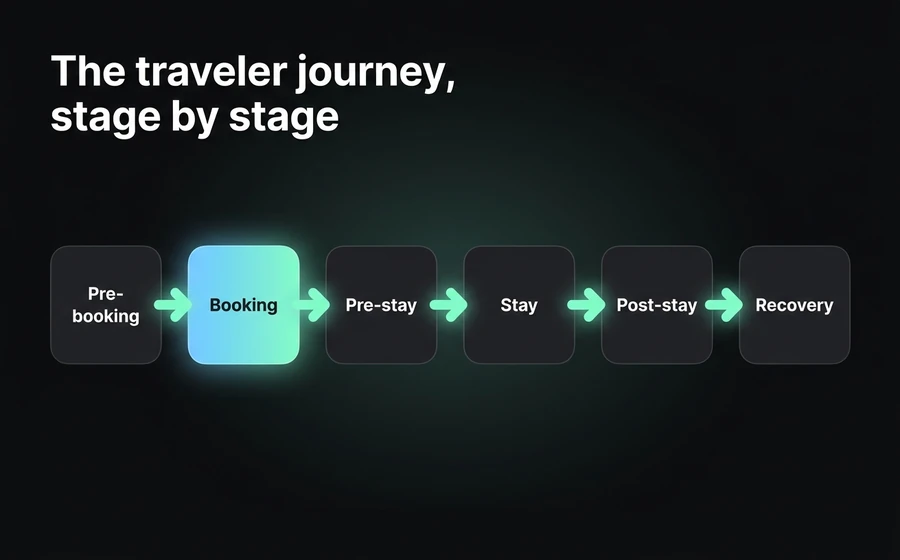
The most useful way to think about a chatbot for tourism isn't by features, but by stages of the customer journey. Each stage has a dominant guest question and a concrete AI agent action. This is the full path, from the first inquiry to loyalty:
| Stage | What the guest asks | What the AI agent does |
|---|---|---|
| 1. Pre-booking | "Do you have availability? How much is it?" | Checks availability in real time, quotes, answers questions in their language |
| 2. Booking + confirmation | "I want to book / pay" | Takes the booking, charges via integrated gateway, sends confirmation instantly |
| 3. Pre-stay | "How do I get there? Can I check in early?" | Sends check-in info, arrival instructions, offers upsells (upgrade, transfer) |
| 4. During the stay | "Where should I have dinner? Can you bring towels?" | Concierge: recommendations, room service, orders, handling of incidents |
| 5. Post-stay | (silence) | Requests a review, says thanks, triggers a loyalty campaign for the next visit |
| 6. Recovery | (incomplete booking) | Detects the abandonment and re-engages with a personalized reminder |
Let's look at the stages with the most operational density.
Pre-booking: speed and instant quoting
This is where the sale is won or lost. The guest is comparing, their intent is high, and their patience is low. The AI agent answers the availability and price inquiry in seconds, in the right language, and keeps the conversation warm until it pushes the booking. If the inquiry came from an ad, it already arrives with context (we cover this in the Click-to-WhatsApp Ads section). The critical thing is that no one is left waiting: a reply in five minutes converts far more than one in five hours.
Booking + confirmation: closing without friction
Once the guest decides, the bot takes the details, confirms final availability, charges through the integrated gateway, and issues the confirmation on the spot. The immediate automated confirmation isn't just tidiness: it's what gives the traveler the assurance that their booking exists, and what prevents the "is it confirmed?" inquiries that later overwhelm your team.
Pre-stay: information and upsells
Between the booking and the arrival there's a golden window that most businesses waste. The agent proactively sends the check-in information, how to get there, what to bring —and takes the chance to offer upgrades: a room upgrade, an airport transfer, an extra excursion, late check-out. It's incremental revenue on a sale already made, at zero marginal cost.
During the stay: digital concierge
While the guest is staying, that same WhatsApp becomes a concierge: restaurant and activity recommendations, room service orders, reporting an issue in the room. It resolves inquiries without the guest having to come down to the front desk or call, and it keeps the experience premium even if your team is small.
Post-stay: reviews and loyalty
When the traveler leaves, the journey doesn't end. A well-timed message asking for a review multiplies positive reviews (people leave them when you ask well, not spontaneously). And a loyalty campaign —an offer for the next season, a perk for returning— turns a one-time guest into a recurring one. The cost of retaining is a fraction of acquiring, and in tourism the customer who returns brings others.
Use cases by sub-vertical: hotel, agency, tour operator, short-term rental
"Tourism" isn't a homogeneous business. A hotel, a travel agency, a tour operator, and a short-term rental have different cycles, pain points, and opportunities. The chatbot for tourism is configured differently in each. This table sums up the map:
| Sub-vertical | Main pain point | What the AI agent automates | Intended impact |
|---|---|---|---|
| Hotel / Hostel | International inquiries after hours, booking no-shows | Availability, booking, check-in info, concierge, reminders | More direct bookings, lower OTA commissions, fewer no-shows |
| Travel agency | Intensive advising per package, scattered leads | Package quoting, FAQ, lead qualification, follow-up | Closing high-ticket packages without overwhelming the advisor |
| Tour operator / Excursions | No-shows on spots, weather dependence, group languages | Spot booking, anti-no-show reminders, change notices, multilingual | Spot occupancy, less loss from no-shows |
| Short-term rental | Remote check-in/out coordination, repeated questions | Access instructions, house rules, availability, reviews | Frictionless remote operation, better ratings |
| Transfers | Schedule coordination, flight confirmation | Transfer booking, confirmation, reminder with time | Punctuality, fewer last-minute cancellations |
Hotel and hostel
A hotel's big goal is to win back the direct booking that today goes to OTA commissions. WhatsApp is the channel where a guest who found you —in an ad, on Google, through a recommendation— can book directly with you without intermediaries. The AI agent handles the international inquiry after hours, confirms instantly, and, once inside, acts as a concierge. In hostels, moreover, the volume of repeated inquiries (how to get there, hours, what the bed in a shared dorm includes) is extremely high and perfect to automate.
Travel agency
An agency sells complex, high-ticket products: packages, cruises, tours. The advising is intensive and leads arrive from many sources. Here the AI agent does the first filter: it answers the frequent questions about each package, qualifies the lead (budget, dates, number of people, destination) and passes it to the human advisor already warm, with full context. The advisor spends their time closing, not answering "how much is it?" fifty times. If you want to go deeper on how to qualify leads automatically, we cover it in qualifying WhatsApp leads with an AI chatbot.
This isn't theoretical. KMB Go, an online retail travel agency from Córdoba, had its channels scattered and delays of up to 24 hours in high season. With an AI agent answering on WhatsApp —routing each inquiry to sales or support— it went from replying in 24 hours to doing so in under 2, expanded service to 24/7, and saw its monthly sales grow by up to 88%. The team stopped firefighting and focused on closing packages. The full case is in how KMB Go went from 24 hours to 24/7 with AI.
Tour operator and excursions
The tour operator's number one enemy is the no-show: spots sold that don't show up, lost revenue that's never recovered. Automated reminders before departure tackle this head-on. Add change notices (weather, schedule) and multilingual service for groups of different nationalities, and the AI agent goes from being a convenience to an occupancy tool. Excursions are managed very well as scheduled appointments/spots —something that online appointment management via WhatsApp solves conversationally.
Short-term rental
Here everything is remote. The host isn't at the door to greet you. The AI agent delivers the access instructions at the right moment, answers the house rules, coordinates check-in and check-out without calls, and afterward asks for the review. For a business that lives on its ratings, automating communication well is what sustains the high score that brings the next bookings.
Recovering abandoned bookings
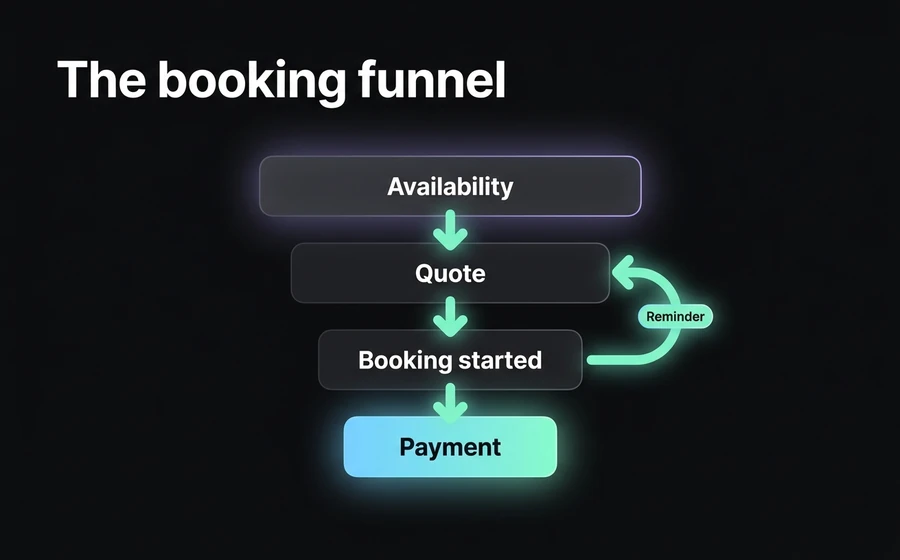
In tourism, the equivalent of the e-commerce abandoned cart is the booking that was started and not completed. The traveler checked availability, liked it, got all the way to the payment step… and something interrupted them: a distraction, a doubt, a comparison with another option. That booking isn't lost; it's paused. And it's one of the most profitable recoveries there is, because the purchase intent was already proven.
The AI agent detects the incomplete booking and triggers a personalized follow-up on WhatsApp: a friendly reminder with the dates the traveler had chosen, the option to pick up where they left off, and —if it makes sense— an incentive to close. The key is timing and tone: neither too soon nor invasive. Done right, it recovers a percentage of sales that would otherwise have quietly evaporated.
The mechanics are the same ones conversational e-commerce applies, adapted to tourism. If you want the detail on how to structure these recovery flows —time windows, tone, message sequence—, we develop it in recovering abandoned carts via WhatsApp. And for re-engagement campaigns at scale —for example, reactivating guests from previous seasons before the next peak—, Wadalio lets you send personalized bulk reminders while respecting Meta's rules.
Click-to-WhatsApp Ads: capturing the traveler from the ad
Most travelers discover destinations and offers on Instagram and Facebook. The classic problem is the leakage between the ad and the booking: the user clicks, lands on a page, gets distracted, and never completes anything. Click-to-WhatsApp Ads (CTWA) cut that path short: the ad opens a WhatsApp conversation with your business directly.
For tourism this is especially powerful because the decision is emotional and conversational. The traveler sees the photo of the resort, clicks, and instead of a cold form finds an AI agent that greets them, answers availability for their dates, and advises them through to the booking —instantly, in their language, without a human having to be watching. That raises the ROI of the ad spend: every ad dollar lands in a conversation that actually converts, not in a click that goes cold.
The bot receives these leads en masse, advises them all in parallel, and passes to the team only those that need a human. The detail on how to implement CTWA with good attribution —ctwa_clid, Conversions API, real measurement— is in Click-to-WhatsApp Ads and conversion in 2026.
How to implement it step by step
Going from the idea to a working tourism AI agent follows a logical order. These are the steps, in sequence:
Step 1: Enable WhatsApp Business API
Your business's number on the official API is the foundation. It lets you operate with multiple agents, automate, use templates for outbound messages, and connect the AI agent. It's not the regular WhatsApp Business app: it's the enterprise infrastructure that supports volume and automation. A good partner handles the setup and verification for you.
Step 2: Define the AI agent's scope
List the inquiries you want the agent to resolve on its own: availability, prices, what's included, how to get there, cancellation policy, check-in. And define the triggers for handoff to a human: group negotiations, complaints, requests outside the catalog. The clearer the scope, the better the experience —an agent that tries everything and fails is worse than one that handles the well-defined scope well and hands off the rest.
Step 3: Connect availability and payments
Here is the heart of the value. The agent has to check real availability and be able to take the booking, not just chat. Via API it integrates with your PMS or booking engine and with your payment gateway to charge within the same conversation. AsisteAPI is the piece that connects your tourism management systems with the platform so information flows in real time.
Step 4: Load the multilingual knowledge
A generative AI agent feeds on your information: rates, services, location, policies, FAQ. That knowledge base is what lets it respond accurately and in the guest's language. The better curated it is, the less it hallucinates and the more reliable it is. We explain the architecture of how that knowledge is structured in the three knowledge layers of an AI agent.
Step 5: Set up reminders and confirmations
Define the journey's automated messages: immediate booking confirmation, check-in/tour/transfer reminder, post-stay review request. Each with its own timing. This is what tackles no-shows and keeps the guest informed without manual work.
Step 6: Connect Ads and campaigns
Activate Click-to-WhatsApp Ads so paid traffic lands directly in the conversation, and prepare the loyalty and re-engagement campaigns for the season. Here the loop closes between acquisition, conversion, and retention.
Step 7: Measure and improve
Once it's running, look at the metrics (we cover them below), review the conversations where the agent handed off or failed, and adjust the knowledge base and the flows. An AI agent improves with use; continuous retraining is part of the job, not a failure.
Common mistakes
Treating the bot as an answering machine, not a salesperson
The most common mistake is configuring the chatbot only to answer FAQ and nothing more. In tourism, the value lies in having it advance the booking: quote, take details, charge, confirm. A bot that only informs leaves the guest halfway and passes the ball to a human who may not be there. Design the flow to close, not just to answer.
Not covering your real customers' languages
If your audience is international and your agent only serves well in Spanish, you're leaving money on the table. Look at where your guests come from and make sure the agent responds naturally in those languages. It is, literally, the channel's biggest differentiator in this sector.
Generic or ill-timed reminders
A reminder that arrives late or sounds like spam produces the opposite of what's intended. The anti-no-show reminder has to arrive at the right moment (not twelve hours before nor five minutes before) and be specific: dates, time, what to bring, how to get there. Personalized and timely, it reduces no-shows; generic and badly timed, it annoys.
Not integrating with the real management system
An agent that says "we have availability" without checking the real system ends up overselling and creating a problem worse than the one it solved. Integration with the PMS/booking engine isn't optional: it's what makes the answers true. Without it, you automate errors at scale.
Removing the human entirely
Automation done right doesn't erase the human: it relocates them. The AI agent takes the high-volume front line and the human steps in where they add judgment —groups, special cases, complaints. If the handoff doesn't exist or is clumsy, the experience breaks at precisely the highest-value moments. The good news is that with an omnichannel inbox the handover is seamless and the guest doesn't even notice.
Metrics that matter in tourism
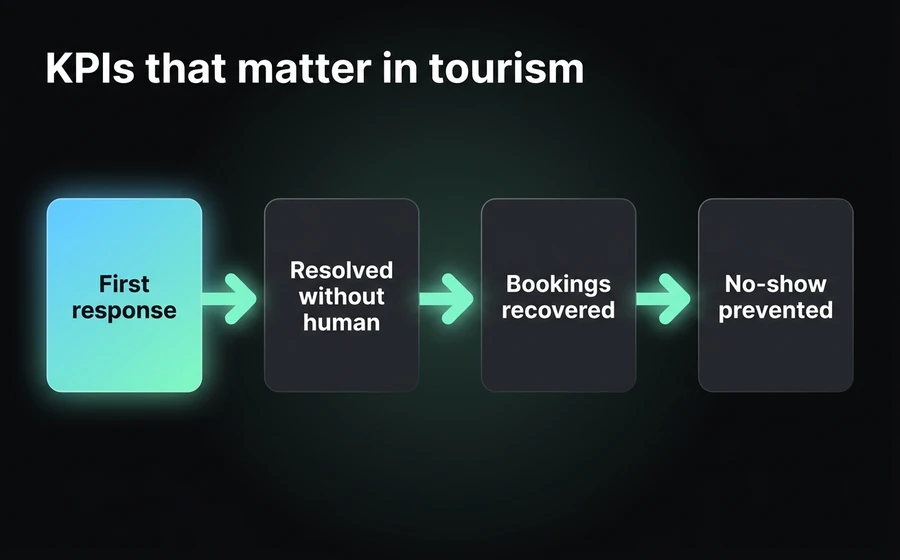
To know whether your chatbot for tourism is working, look at these metrics, not the number of messages sent:
- First response time. In tourism, seconds vs. hours defines conversion. The goal with an AI agent is an immediate response, 24/7.
- Resolution rate without a human (deflection). What percentage of inquiries the agent resolves on its own. The higher it is, the more operational capacity you free up.
- Inquiry-to-booking conversion rate. The number that truly matters: of the inquiries that come in, how many end in a confirmed booking.
- No-shows avoided. How many bookings/spots that would have been lost were held thanks to the automated reminders.
- Recovered bookings. How many abandoned bookings the agent re-engaged through follow-up.
- Reviews generated. The effect of asking for a review at the right moment, post-stay.
We work through the general pattern of how to lower service time without losing quality in AHT benchmarks on WhatsApp, applicable to any high-volume vertical like tourism.
Conclusion
Tourism is, probably, the sector where a chatbot for tourism —understood as a multilingual 24/7 AI agent on WhatsApp— produces the clearest return. Not because it's trendy, but because of the nature of the business: global customers, fast decisions, a high volume of repeated inquiries, and a brutal cost to not replying on time or in the right language.
If you take away three ideas: first, that multilingual 24/7 service is the differentiator that captures the highest-value international traveler. Second, that the agent has to cover the full journey —from the availability inquiry to the post-stay review—, not just greet. And third, that the real value appears when it integrates with your management system: real availability, payment within the conversation, reminders that avoid no-shows, and recovery of abandoned bookings.
At AsisteClick we help tourism businesses set this up end to end: our team handles the WhatsApp Business API setup, the integration with your PMS and payments, and the fine-tuning of the AI agent. If you want to see how it would look for your hotel, agency, or tour, the solution for tourism is the place to start, and the plan that fits best depends on your volume.
Frequently asked questions
What is a chatbot for tourism?
A chatbot for tourism is an automated assistant —ideally an AI agent— that serves travelers on WhatsApp or other channels, managing availability, bookings, confirmations, reminders, and guest service around the clock. Unlike a simple menu bot, an AI agent understands context, responds in the customer's language, and can advance the booking end to end, handing off to a human only when needed.
How does a chatbot help a hotel receive bookings via WhatsApp?
A chatbot lets the hotel receive bookings via WhatsApp by checking availability in real time, taking the guest's details, charging through an integrated gateway, and sending the confirmation instantly, without manual intervention. This enables direct bookings at any hour —even from guests in other time zones— and reduces dependence on OTAs and their commissions.
Is automated multilingual service useful for tourism?
Yes, and it's the sector's biggest differentiator. An AI agent detects the guest's language and responds in that language naturally, serving travelers from many countries at the same time without the need for polyglot human agents on rotating shifts. For a business with an international audience, this is the difference between capturing or losing the highest-value customer.
How does a chatbot reduce no-shows in tours and bookings?
A chatbot reduces no-shows by sending automated reminders and confirmations at the right moment before check-in, the tour, or the transfer, with the specific information the customer needs (date, time, how to get there). By keeping the booking top of mind and resolving last-minute questions, it prevents the absences that otherwise translate into lost spots and revenue.
Can a booking the customer didn't complete be recovered?
Yes. The AI agent detects when a traveler started a booking and didn't finish it, and triggers a personalized follow-up on WhatsApp with a reminder of the chosen dates and the option to pick up where they left off. Since the purchase intent was already proven, it's one of the most profitable sales recoveries in the sector.
Do I need to replace my management system (PMS) to use a chatbot?
No. A chatbot for tourism integrates with your existing PMS, booking engine, CRM, and payment gateway via API, syncing information in real time without replacing your current systems. The agent checks real availability and records bookings in your management system, avoiding overselling and maintaining a single source of truth.